

 4.9/5
4.9/5- 122
- Beginner
- English
 4.9/5
4.9/5 122
122 Beginner
 English
AML Foundations (ABC): AML Training for Funds & Trading
 CPD-Certified Course
 - Fund and trading structures: how an AIFMD-scope alternative fund, a UCITS and a MiFID II investment firm each carry different AML duties, and which entity in the chain owns which control.
- Investor onboarding: subscription and redemption flows, the transfer agent’s file, nominee and omnibus accounts, and the beneficial ownership chain sitting behind a limited partner (LP).
- Source of funds and source of wealth: what a fund administrator has to evidence for a private equity or hedge fund investor, and the point at which enhanced due diligence starts.
- Securities typologies: layering through multiple accounts and jurisdictions, wash trading, mirror trading, free-of-payment movement of securities, and where trade-based money laundering does and doesn’t overlap with securities trading.
- Market abuse alongside AML: insider dealing and front-running sit under the Market Abuse Regulation (MAR), laundering sits under the AML rulebook, and one surveillance function usually sees both sets of alerts.
- Screening and monitoring: PEP and sanctions screening across investors, counterparties, custodians, depositaries and prime brokers, and how transaction monitoring is calibrated for a trading book rather than a retail current account.
- The rulebook and who enforces it: the EU AML Regulation and AMLD6 that apply from 10 July 2027, alongside ESMA, the FCA, the CSSF, the AMF, BaFin and the Central Bank of Ireland.
- Reporting and conduct: writing an STR a financial intelligence unit can act on, escalation lines that hold under commercial pressure, and the difference between a code of ethics and a code of conduct.
 3 hours of on-demand video
  26 Submodules of reading material
  30 Assignments
  Final Exam
  8.15 CPD Credits
  26 Visual Schemes
  Certificate of Completion
  2 weeks – Recommended Learning Timeline


Train your team on the risks that sit inside fund and trading operations rather than on a generic banking syllabus. AML Foundations (ABC) for Funds & Trading gives new hires, transfer agent and investor-onboarding staff, trade surveillance analysts and fund administration teams one shared baseline before they touch a subscription file or an alert queue.
It is self-paced, so nobody leaves the desk for a scheduled classroom, and each learner’s completion is recorded against the certificate. And that matters when a supervisor asks what training your AML staff actually received and when. Use the form for multi-seat pricing.

AML training for investment funds, fund administration and trading desks
Built for people who handle investor files, fund flows or trade surveillance and have been handed AML duties without an AML background. It is the entry point before CASS, the Certified Anti-Money Laundering Specialist.
AML job market snapshot (LinkedIn) Source of data: LinkedIn Jobs · Last update: 23.12.2025 · Counts are point-in-time and move week to week
- 🇪🇺 European Union 11 707 open positions in total · 1 113 entry-level open roles · ≈ 3 610 remote open roles
- 🇬🇧 United Kingdom 3 704 open positions in total · 290 entry-level open roles · ≈ 683 remote open roles
- 🇺🇸 United States 1 834 open positions in total · 620 entry-level open roles · ≈ 124 remote open roles
- 🇦🇪 UAE 235 open positions in total · 40 entry-level open roles · ≈ 45 remote open roles
Read against the roles themselves, the pattern is narrower than the totals suggest. Most fund-side openings are not titled “AML” at all. They are transfer agent, investor services, investor onboarding, fund administration and trade surveillance roles that carry AML duties inside the job description, which is why they surface for compliance searches and why candidates without a fund background get filtered out early. So the entry-level share matters more here than the headline count.
This course teaches anti-money laundering, counter-terrorist financing and wider financial crime (AML/CTF+) through the operations of investment funds, asset managers and trading firms rather than through retail banking examples. The distinction is practical, not cosmetic. A fund’s money-laundering exposure arrives through investors and counterparties, not through a branch counter, and it usually arrives through an intermediary, so nobody in the chain sees the whole picture. And that shapes every control you will study here.

- Financial crime and predicate offences as they present in securities markets: fraud, insider dealing, market manipulation and the proceeds that need somewhere to go.
- Risk assessment for a fund or trading business: investor risk, product risk, distribution risk, jurisdiction risk, and why in capital markets the customer usually outweighs the product.
- The compliance programme: KYC, CDD and enhanced due diligence, ongoing monitoring, sanctions screening, suspicious transaction reporting, and terminating a relationship without tipping off.
- Investor due diligence in practice: verifying an entity investor, working through nominee and omnibus holdings to the natural persons behind the structure, and documenting source of funds and source of wealth.
- Reliance and outsourcing: when a fund can rely on a distributor, an administrator or an introducing broker to have done the CDD, and why the relying party still carries the liability.
- Regulatory frameworks: who supervises a ManCo, an AIFM, a MiFID II investment firm and a fund administrator, what the EU AML Regulation and AMLD6 change from 10 July 2027, and what non-compliance costs.
- Ethics and conduct: the difference between a code of ethics and a code of conduct, and where each one bites on a trading floor.
The AML Foundations (ABC) for Funds & Trading course is provided by the AML Certification Centre, a CPD-accredited training provider founded in Tallinn, Estonia in 2023. Over 5,000 professionals across more than 79 countries have been trained through its programmes. The course is self-paced and fully online, so a learner in Dublin, Luxembourg or Dubai works through the same material on their own schedule. But most people finish inside the recommended two weeks while working full time.
- Learning method: online, self-paced
- Course materials: 10 hours of reading across 26 submodules
- Video materials: 3 hours
- Format: video, written material, 26 visual schemes and diagrams
- Assignments: 30
- Interactive quizzes: yes
- Practical materials: yes
- Final exam: 30 questions, 60-minute time limit
- Exam passing threshold: 80%
- CPD credits: 8.15
- Recommended timeline: 2 weeks
- Access: lifetime
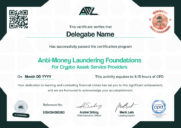
Passing the final exam earns a Certificate of Completion from the AML Certification Centre, carrying 8.15 CPD credits. It records that you completed a CPD-accredited programme covering AML/CTF+ fundamentals and their application in investment funds, asset management and trading, and that you passed a 30-question assessment at an 80% threshold.
Now the part most course pages leave out. This is a training certificate, not a licence and not a regulatory approval. It is not endorsed, approved, mandated or recognised by ESMA, the FCA, the CSSF, the AMF, BaFin, the Central Bank of Ireland or any other supervisor, and no training provider’s certificate is. But what it does is evidence, on the record and with a date, that a named member of staff received AML training appropriate to their role — which is what a supervisor asks a firm to demonstrate.
What this course does not cover
Being straight about scope saves everyone a refund request.
This is a foundation course. It won’t make you an MLRO, it doesn’t design your firm’s business-wide risk assessment for you, and it isn’t a substitute for jurisdiction-specific legal advice on how the CSSF, the Central Bank of Ireland or the FCA applies a rule to your particular structure. No vendor’s transaction monitoring or screening software is taught here. And it stops short of the sectoral non-AML parts of AIFMD, UCITS or MiFID II — depositary duties, valuation, best execution, prospectus and disclosure obligations — beyond explaining where they meet the AML controls you are studying.
So if you already run an AML programme and need the design-and-defend level, CASS is the course, not this one.
- English at B2 or above. The material uses regulatory language and the exam is in English.
- Basic computer and internet skills. Everything runs in a browser.
- No prior AML experience. The course starts from what money laundering is and builds up.
- No prior fund or trading experience either, although it helps. If you already know what a subscription, a redemption and a settlement cycle are, the sector modules will move faster.
- An interest in anti-money laundering, counter-terrorist financing, proliferation financing and wider financial crime as they apply to funds, asset management and securities trading.
Who this course is for
- Fund administration and transfer agency staff who process subscriptions and redemptions and hold the investor file.
- Investor onboarding and investor relations analysts at a private equity, hedge fund or real assets manager, who collect source of funds and source of wealth from a limited partner and then have to defend that file.
- Trade surveillance analysts who already watch for market abuse and have been asked to spot money laundering in the same order flow.
- Compliance officers and deputy MLROs at an AIFM, a UCITS management company or a MiFID II investment firm, who need the fund-sector version of AML rather than the banking one.
- Operations, middle office and client onboarding teams at brokers, custodians and prime brokers, who see the transaction but rarely the underlying investor.
- Career changers moving into financial crime from audit, legal, operations or client services, who need the vocabulary before an interview.
Buying seats for a team
Firms buy this course for a different reason than individuals do. An individual wants the certificate on a CV. But a head of compliance wants a dated, per-person record that a defined group of staff received AML training matched to what they actually do, because that is the form the question takes when it comes from a supervisor or an internal audit.
Self-paced delivery is the practical part. A fund administrator running a December subscription cycle can’t send twelve people to a scheduled classroom, and the alternatives in this market largely are scheduled classrooms in one jurisdiction. So use the For Business form for multi-seat pricing.


- What are Financial Crimes?
- Typology of Financial Crimes
- Consequences and Impacts of Financial Crime
- Inherent risk, controls and residual risk, and how the three fit together on a page a supervisor will read
- Financial crime risk in a fund or trading business: investor, product, distribution, jurisdiction and delivery-channel factors
- Why in capital markets the customer usually drives more risk than the instrument being traded
- The business-wide risk assessment, and how a customer risk assessment sits underneath it
- Risk appetite, escalation and the decision to decline or exit a relationship
- What a compliance programme contains, and who owns each part
- KYC and customer due diligence, applied to an entity investor rather than an individual
- Beneficial ownership: working through nominee, omnibus and layered holding structures to the natural persons behind them
- Ongoing due diligence and periodic review, and the trigger events that force a refresh
- Sanctions and PEP screening, including screening counterparties, custodians and prime brokers rather than only investors
- Reporting suspicious activity (SAR/STR): what goes in the narrative, and what tipping off means in practice
- Terminating a business relationship, and how a redemption is handled when the investor is under suspicion
- Which businesses are obliged entities, and why funds, ManCos, investment firms and fund administrators sit inside the perimeter while some of their service providers do not
- How obligations differ between a bank, an EMI, a VASP, a gambling operator and a fund, and why a banking AML syllabus transfers badly to a fund
- Where the fund sector’s duties are split between the fund, the manager, the administrator and the distributor, so the same control is neither duplicated nor dropped
- International Organisations and Frameworks in AML/CTF+
- Who is the Regulator?
- AML/CTF+ difference by country and industry
- Consequences of non-compliance
- Importance of Code of Ethics and Code of Conduct
- Comparison of Code of Ethics and Code of Conduct
- How the investment funds industry is structured: AIFMD-scope alternative funds, UCITS, ManCos, AIFMs, fund administrators, transfer agents, depositaries, custodians and prime brokers
- Where money laundering enters a fund: investor onboarding, subscription and redemption flows, in-specie transfers and secondary transfers of LP interests
- Source of funds and source of wealth for fund investors, and beneficial ownership through nominee, omnibus and feeder structures
- Money laundering typologies in securities trading: layering across accounts and jurisdictions, wash trading, mirror trading, free-of-payment movement of securities and option-premium schemes
- Market abuse and AML side by side: insider dealing and front-running under MAR, and how the same order flow raises both kinds of alert
- Trade-based money laundering, and why it is a trade-in-goods typology rather than a securities-trading one
- Transaction monitoring, PEP and sanctions screening calibrated for a trading book
Which rulebook applies to a fund, and who enforces it
A fund business rarely sits under one regime. The sectoral rules — AIFMD for alternative funds, the UCITS Directive for retail funds, MiFID II and MiFIR for investment firms — govern authorisation, delegation, depositary arrangements and conduct. The AML rulebook runs alongside them and asks a different question: who is your investor, where did the money come from, and can you show your work.
Two consequences follow, and both catch people out.
First, the AML duties are split. The fund, the management company, the administrator and the distributor each hold part of the control, and the split has to be documented so that the same check is neither performed twice nor missed entirely. Second, the sectoral regime doesn’t discharge the AML one. Being an authorised AIFM says nothing about whether your investor files would survive an inspection.
In the EU, Regulation (EU) 2024/1624 — the AML Regulation — and the sixth AML Directive apply from 10 July 2027, moving much of the detail from national transposition into directly applicable rules. And supervision is national, and it varies in temperament: the CSSF in Luxembourg, the Central Bank of Ireland, the AMF in France, BaFin in Germany, and the FCA in the United Kingdom, which is outside the EU regime and runs its own. ESMA sits above the sectoral markets rules rather than the AML ones, which is a distinction worth getting right before an interview.
Market abuse and money laundering: two rulebooks, one order flow
Trading firms usually build market abuse surveillance first. Insider dealing, front-running and manipulation are what MAR asks about, the alerts are well understood, and the vendor tooling’s mature. So when AML lands on the same desk, the assumption is that the existing surveillance covers it.
It doesn’t, and this is the specific failure the FCA recorded in its capital-markets review: some of the firms it visited were focused solely on identifying market abuse and had not considered the risk that they might be used to launder money at all.
But the two overlap without being the same. Market abuse asks whether a trade was fair. AML asks whether it was real — whether the pattern makes economic sense, or whether the account is being used to move value and produce a plausible history for it. Wash trades, mirror trades, uneconomic strategies, free-of-payment movements of securities, over-collateralisation returned by a prime broker, cash in and cash out with no trading in between: these read as odd to a surveillance system and as laundering to an AML analyst.
There’s a structural reason the second question is harder. In a trading chain an order routes through several firms, and each one generally sees only its own direct customer. Nobody sees the whole chain, and there is no obligation to know your customer’s customer. So each firm’s CDD is load-bearing for everyone downstream of it.
Where this course takes a fund or trading professional
Follow a structured path from foundation to leadership in financial compliance

25-40% higher chance
of securing job interviews

92% feel more confident
when applying for AML jobs

82% graduates promoted
within 8 months

Alumni in 79+ countries
global network
Trusted by professionals from leading companies
Our courses have been taken by compliance, operations and risk staff at banks, payment firms, fund administrators, asset managers and brokers, alongside consultancies and technology companies serving them.





















Ready to move into fund and trading compliance?


Frequently
Asked
Questions
Who is this course for in a fund or trading business?
How is the course delivered, and how long does it take?
What will I actually be able to do at my desk afterwards?
What certificate do I get, and is it accredited?
Do I need fund or trading experience before I start?
Does the course cover AIFMD and UCITS fund structures?
Where do market abuse rules and AML overlap?
Does it cover source of wealth checks on fund investors?
How do I work through nominee and limited partner ownership chains?
Does the course cover transaction monitoring for a trading book?
Does it cover the EU AML Regulation and AMLD6?
Does the course cover trade-based money laundering?
How is this different from the general AML Foundations course?
Will this satisfy our supervisor’s staff training expectation?
Can my firm buy several seats and pay by invoice?
Not sure which level you need?
Move from operational AML knowledge to specialist-level expertise recognised across regulated sectors.
On the call we will go through:
- Your current professional level
- Roles you can qualify for and the skills required
- Overview of your local regulatory requirements
- Your realistic career pathways and growth scenarios
After you finish the course:
- Your chances of landing an AML/Compliance role increase by 37%
- You become eligible for higher-level positions
- You’ll gain deeper, structured AML expertise
- You can present a recognized certification to employers