
 4.8/5
4.8/5- 2,368
- Beginner
- English
 4.8/5
4.8/5 2,368
2,368 Beginner
 English
AML Foundations Course
 CPD-Certified Course
 - AML Foundations is the entry point to the AML Certification Centre catalogue, and it assumes you are starting from zero. Money laundering is normally described in three stages – placement, layering and integration – and almost every control you will meet in the job exists to interrupt one of them. The course was created by experts with real-world experience in investigations, compliance, and law enforcement, so the framing is what a first-line analyst does on a Tuesday morning rather than a reading list.
- The programme covers the main types of financial crime and the predicate offences behind them – corruption, cybercrime, drug trafficking – alongside terrorist financing. It then works through how firms respond: the risk-based approach, customer due diligence at onboarding, ongoing monitoring of behaviour against the profile you opened the account with, sanctions compliance, and the point at which an internal escalation becomes a suspicious activity or transaction report. Risk management, the structure of compliance programmes, the role of the regulator, the consequences of non-compliance and professional ethics all sit inside the six modules.
- But nothing here is locked to one jurisdiction. The material is written against international AML/CFT standards and FATF Recommendations, which is what makes it portable across the EU, the US, the UK and the UAE. That’s deliberate. AML Foundations is sector-neutral on purpose, and the sector detail lives in the five vertical courses that come after it.
AML Foundations costs €399, one-time, with lifetime access. The fee can be paid in instalments over 2 or 3 months.
 3 hours of on-demand video
  22 Reading Materials
  30 Assignments
  Lifetime Access
  10 CPD Credits
  26 Visual Schemes
  Certificate of Completion
  2 weeks – Recommended Learning Timeline


Train new hires on one syllabus instead of five different induction decks. AML Foundations suits onboarding and KYC teams, frontline operations, and anyone in a first-line role who needs a working grounding in AML/CFT before they touch a real customer file. Each seat carries 10 CPD credits and a CPD-accredited certificate with a public verification link, so the training is evidenced rather than asserted. Seats are bought per learner, invoiced to the company, and there’s no annual membership attached. Where your staff need sector depth afterwards, the five vertical Foundations courses cover banking, EMIs, crypto-asset firms, gambling and iGaming, and funds and trading.

What the AML Foundations course covers
Built for people entering financial crime prevention without a compliance background. AML Foundations is the sector-neutral base of the catalogue: take it first, then a €499 sector vertical, then CASS certification at senior level.
AML job market snapshot (LinkedIn) Source of data: LinkedIn Jobs · Counted on 23.12.2025 · figures not re-counted since that date
- 🇪🇺 European Union 11 707 open positions in total · 1 113 entry-level open roles · ≈ 3 610 remote open roles
- 🇬🇧 United Kingdom 3 704 open positions in total · 290 entry-level open roles · ≈ 683 remote open roles
- 🇺🇸 United States 1 834 open positions in total · 620 entry-level open roles · ≈ 124 remote open roles
- 🇦🇪 UAE 235 open positions in total · 40 entry-level open roles · ≈ 45 remote open roles
Demand for AML and financial crime staff holds up across the EU, the UK, the US and the GCC, and a steady share of those openings are entry-level and remote. For someone with no compliance history the realistic first titles are KYC analyst, onboarding analyst, AML analyst, transaction monitoring analyst, screening analyst, and compliance assistant. All of them are first-line roles: you check identity and beneficial ownership at account opening, screen names against sanctions and PEP lists, work alerts against a customer’s expected behaviour, and write up what you found so someone senior can decide whether it becomes a report. A certificate doesn’t replace that experience. But it gets you readable on a shortlist and gives you the vocabulary to answer interview questions about due diligence and escalation.
Where AML Foundations sits on the route from first job to Head of Compliance
Visual Timeline
AML Foundations
KYC / onboarding / AML analyst
CASS
AML officer, compliance specialist, deputy MLRO
CAPS
Head of Compliance, MLRO
What AML Foundations changes for a career-changer
A structured route from a first AML/KYC role to a compliance leadership one, taken in the order the catalogue is built: Foundations, then a sector vertical, then CASS, then CAPS.

25-40% higher chance
of securing job interviews

92% feel more confident
when applying for AML jobs

82% graduates promoted
within 8 months

Alumni in 79+ countries
global network
Starting an AML career from outside compliance
AML Foundations graduates have moved into KYC, transaction-monitoring, and junior compliance roles across banking, EMIs, fintech and crypto-asset firms. Survey methodology and sample size available on request. Most arrive from adjacent work rather than from compliance: customer support in a regulated firm, payments operations, fraud, audit, law, or a finance degree with no AML exposure at all. What the course supplies is the shared vocabulary those teams hire on – due diligence, beneficial ownership, the risk-based approach, escalation – so that a first interview isn’t the first time you’ve used the words.
During your Career Call, we will review:
- Your current professional level
- Roles you can qualify for and the skills required
- Overview of your local regulatory requirements, including how the EU AML Regulation applies from 2027
- Your realistic career pathways and growth scenarios
After Completing the Course:
- Your chances of landing an AML/Compliance role increase by 37%
- You become eligible for higher-level positions
- You’ll gain structured AML expertise: CDD and EDD, the risk-based approach, sanctions screening, and how a suspicious activity report is raised
- You can present a recognised CPD-accredited certificate to employers

AML Foundations is built for two readers. The first is moving into compliance from somewhere else and needs a defensible starting point rather than a scattering of webinars. The second already sits in a first-line seat – onboarding, payments operations, customer support in a regulated firm, fraud, or risk – and is expected to apply AML rules they were never formally taught.
If your day involves any of the following, this is the right level. You collect identity documents and verify them at account opening. You check who ultimately owns and controls a corporate customer, and you’ve hit a structure where that isn’t obvious. You run names against sanctions and politically exposed person lists and have to decide what a partial match means. You look at alerts where a customer’s behaviour has drifted from the profile you opened the account with. Or you have written the file note that goes to someone more senior and weren’t sure how much of it mattered.
It also suits people who need the framework rather than the alerts. Bank staff whose supervisor requires periodic AML training. Staff at crypto-asset and Web3 firms, where exposure is high and EU expectations have tightened. Corporate services, company formation and account-opening providers, who carry due diligence duties on structures they set up. Lawyers and consultants working on cross-border arrangements, who need to know how AML/CFT rules land on a transaction. And founders in higher-risk sectors who would rather understand the controls than meet them for the first time during a bank review.
Two more groups get value from it. Recruiters hiring for AML/KYC and fintech roles can read a candidate’s actual competence instead of a keyword list. And internal audit or control staff can assess whether an AML programme is working. So much of that is impossible without knowing what good looks like.
There’s no prerequisite. No prior AML role, no finance degree, no licence. English at B2 and a willingness to read carefully are the requirements.
AML Foundations aims at working competence rather than exam recall. By the end you should be able to follow an AML/CFT process from account opening to escalation and explain why each step exists.
What you will learn:
- to recognise the main types of financial crime, their causes and their methods, including the stages money passes through as it is laundered;
- to assess and manage risk in an AML/CFT context, which in practice means applying a risk-based approach: more scrutiny where customer, product, country or channel carries more exposure, and proportionate checks where it does not;
- to understand what a compliance programme is made of – policies, controls, customer due diligence, ongoing monitoring, sanctions compliance, record keeping, training and reporting – and how those parts are supposed to fit together;
- to recognise the point at which a case stops being unusual and becomes reportable, and how a suspicious activity or transaction report reaches the financial intelligence unit;
- to identify when risk must be reduced or a business relationship ended, and what happens to the customer file when it is;
- to read the sector differences that follow – why a bank, an e-money institution, a crypto-asset firm, a casino and a fund each carry a different risk profile – which is what the five vertical courses build on;
- to understand the role of regulators and supervisors, where the rules come from, and what non-compliance actually costs.
Special attention is paid to professional ethics. You will learn to distinguish between a Code of Ethics and a Code of Conduct and apply these principles in your professional activities. And that includes the part beginners most often get wrong: an AML obligation is not only about spotting the transaction, it’s also about what you may and may not say to the customer afterwards.


- What are Financial Crimes?
- Typology of Financial Crimes
- Consequences and Impacts of Financial Crime
- Understanding of Risk
- What is Financial Crime Risk?
- Risk Management in AML/CTF+ and Financial Crime
- The importance of financial crime risk management
- How FC risk is managed?
- Understanding of Compliance Program
- Foundations of Compliance Programs
- Foundations of KYC
- Foundations of Ongoing Due Diligence
- Sanctions Compliance
- What is Reporting of Suspicious Financial Activities (SAR/STR)?
- Termination of Business Relationship
Understanding of different business sectors
- International Organisations and Frameworks in AML/CTF+
- Who is the Regulator?
- AML/CTF+ difference by country and industry
- Consequences of non-compliance
- Importance of Code of Ethics and Code of Conduct
- Comparison of Code of Ethics and Code of Conduct
Upon completion of the training, participants must take a mandatory final exam, which is conducted on the same platform where the classes were held. The exam consists of 30 multiple-choice questions. Participants have 60 minutes to complete the exam, and must answer at least 80% of the questions correctly to pass. The results are displayed immediately after the test is submitted.
Students are given three free attempts to pass the exam. If all three attempts are used, further retakes are subject to a fee of €70 each. Retakes are only possible after 15 days to give you time to review and repeat difficult topics.
So what is it actually like? It’s open-book in the sense that nobody is watching you, and closed-book in the sense that 60 minutes for 30 questions leaves about two minutes each. That’s enough time to think and not enough to look everything up. The 80% threshold means six wrong answers is the limit. Questions are drawn from across all six modules rather than weighted to the last one you read, so the 30 assignments inside the course are the better preparation than re-watching video. And the 15-day gap between attempts is not a penalty. It exists because people who resit immediately tend to fail on the same material twice.
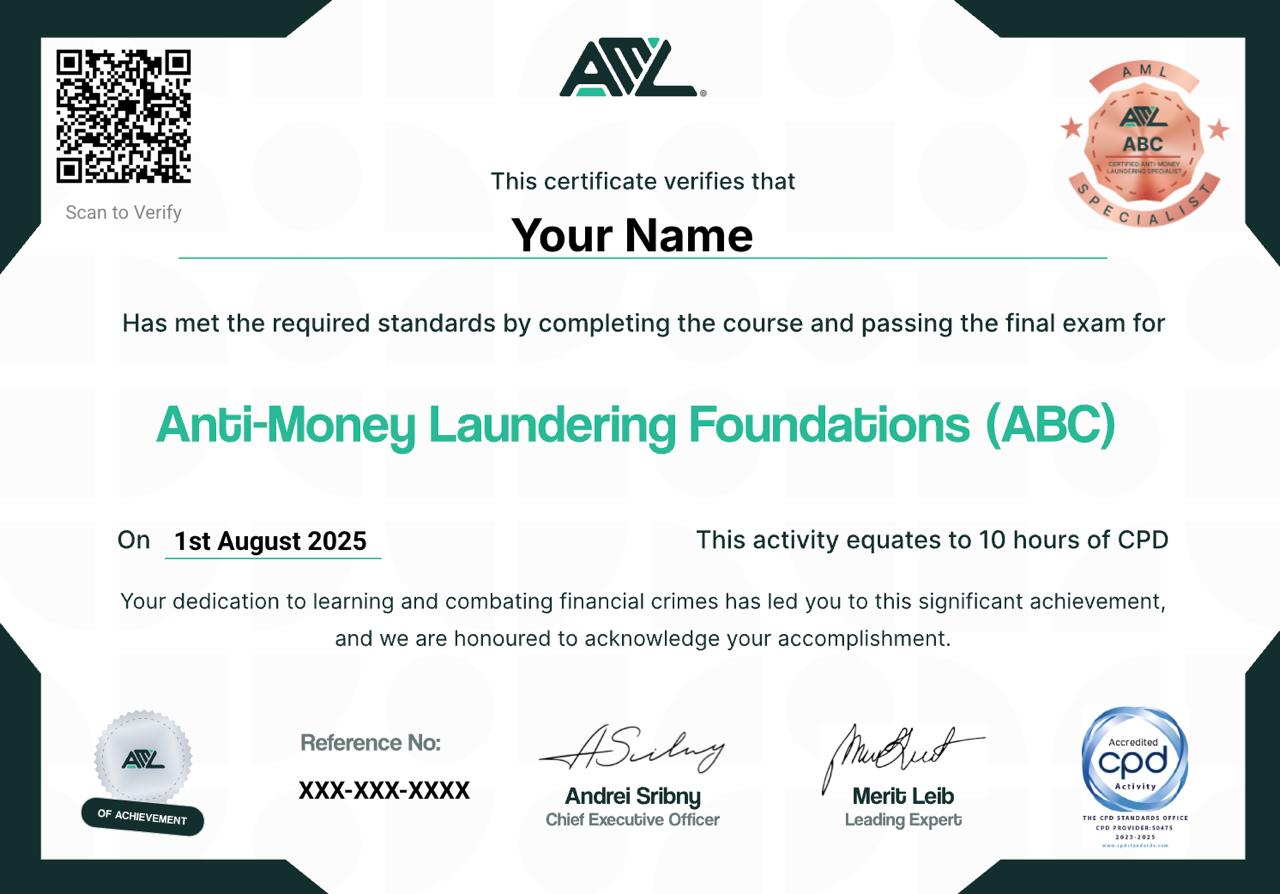
Upon completion of the AML Foundations Course at the AML Certification Centre, you will receive an accredited CPD certificate, officially confirming your mastery of the key fundamentals of AML/CFT+ and successful completion of the final assessment. The certificate carries 10 CPD credits, names CPD Standards Office Provider #50475 as the accrediting body, and includes a public verification link an employer can open without contacting us.
But it’s worth being precise about what that accreditation is and isn’t. CPD accreditation is a quality standard for continuing professional development: it confirms the programme is structured, assessed and worth the credits it claims. It isn’t a licence, and no financial regulator endorses, approves or mandates this certificate. What the course is designed to do is address what supervisors expect AML staff to know – the material is written against international standards and FATF Recommendations, which is why it travels across the EU, the US, the UK, the UAE and other jurisdictions.
The certificate strengthens the position of a specialist when applying for a job in:
- commercial banks and banking groups;
- insurance companies;
- investment funds and management companies;
- cryptocurrency and fintech companies;
- brokerage firms and financial intermediaries;
- government and regulatory bodies, including central banks and financial intelligence units (FIUs).
Employers also accept it as evidence of induction-level AML training, which is a recurring requirement rather than a one-off: the EU AML Regulation keeps ongoing, role-appropriate and documented staff training as an obligation when it starts to apply in 2027.
Trusted by professionals from leading companies
Our courses have been attended by specialists working at companies across various industries, from tech and product teams to digital agencies and startups.




















What People Say About Us

 5/5
5/5
Equipping compliance professionals with the tools to identify and neutralise threats obligated entities face – AML Certification Centre training programs are an effective Anti-Financial Crime toolkit from practitioners for practitioners.
Read More Igoris Krzeckovskis
 5/5
5/5
“This is one of the best AML/CTF training I’ve ever had in my professional career combating financial crime for over than 15 years. In my opinion AML Certification Centre’s AML/CFT course is more valuable and relevant than other similar organizations provide. You can choose the tailored training based on your knowledge level and improve it. If you want to have interesting reading and localized training – you should definitely take it!”
Read More 5/5
5/5
“I was searching for new qualifications and due to high demand for AML specialists my choice fell on this line of work. As a newcomer I took the foundations course. The materials presented to me further ignited my interest, the lessons were well structured, video materials combined with text were especially useful for digesting information. I felt like a few mid-course tests were a bit hard, but upon completion I revised my notes and it all made sense. Overall, I am satisfied with this course and its length, it fit perfectly into my schedule and I want to continue my education with this provider.”
Read More 5/5
5/5
“Awesome course with big amount of materials. The best part is that this course can be done whenever you have time and streight to learn. Thank AML Certification Centre for this course.”
Read More

Frequently
Asked
Questions
I have no compliance experience. Is AML Foundations the right place to start?
What will I actually be able to do after AML Foundations?
How does AML Foundations compare with a free online AML course?
How does AML Foundations differ from the five sector Foundations courses?
What is the AML Foundations exam like?
What do I need before starting AML Foundations?
Can I download the AML Foundations course materials?
How long does AML Foundations take to complete?
Are there any additional fees for AML Foundations?
How do I get the AML Foundations certificate?
Can I ask questions while taking AML Foundations?
Will I have access to the materials after completing the course?
Which sector course should I take after AML Foundations?
Does AML Foundations satisfy an employer’s AML induction training requirement?
Is an AML certificate enough to get a first compliance job?
Can my employer buy several seats and receive an invoice?
How current is AML Foundations against the EU AML Regulation and AMLD6?
Does the AML Foundations certificate expire or need renewing?
How is AML Foundations different from CAMS or the ACAMS foundational course?