Public-sector practitioners
- Financial investigators and law enforcement officers
- FIU analysts and dissemination officers
- Prosecutors, asset recovery and forfeiture specialists
- Customs and tax criminal-investigation teams

Financial investigations & asset recovery
Turn financial intelligence into a supported investigation.
Develop your approach to asset tracing, preservation, evidence and case preparation with experienced practitioners.
Online · Self-paced · In English
For professionals conducting, directing or supporting financial investigations. Entry considers your role and experience.
Building your first-line compliance foundations? Compare AML programmes
FIAR connects the challenges of financial investigation with the skills you practise and the work you produce.
Practise prioritising enquiries, building an asset map and planning preservation measures as the evidence develops.
Early investigation & asset preservation · Modules 3–4Reconstruct relationships across entities and source records. Separate supported findings from assumptions that still need testing.
Ownership, evidence & casework · Modules 4, 5 & 7Work through cooperation routes, institutional responsibilities and the information needed for a cross-border request.
Legal framework & cooperation · Modules 2, 4 & 6Document sources, explain limitations and bring the financial evidence into a clear case file for prosecutorial or court review.
Evidence & case preparation · Modules 5–7Move from understanding the pattern to preserving assets and preparing the case. Each module connects practitioner explanation with applied decisions.
Study through self-paced online modules. Develop your approach through investigative casework and an integrated capstone, then complete the programme assessment. Institutional delivery is agreed with your organisation.
Recognise the patterns behind an investigation.
Explain the typology suggested by the available intelligence and identify what still needs testing.
Understand the framework supporting investigative action.
Identify the relevant framework, competent authority and information needed for a cross-border request.
Build the asset picture before formal proceedings.
Build an asset map, distinguish evidence from assumptions and prioritise the next enquiries.
Preserve recoverable value through the life of a case.
Prepare an asset-preservation approach that considers authority, timing and ongoing management.
Turn information into a traceable evidence record.
Document sources, assess reliability and explain where specialist support is needed.
Prepare findings for prosecution and court review.
Present a clear account of the evidence, its limitations and the basis for the proposed action.
Bring the investigative cycle together.
Connect the intelligence, asset picture, supporting evidence and unresolved questions in one case file.
Understand the standards and cooperation mechanisms around asset recovery, then apply them through the relevant national law and institutional mandate.
Recommendations 4 and 38 address recovery measures and international cooperation. Immediate Outcome 8 assesses the effectiveness of a country’s asset-recovery system.
Asset-recovery standards IO.8 methodologyDirective (EU) 2024/1260 provides a legal context for tracing, freezing, confiscation and asset management. National implementation determines the applicable procedures and powers.
Read the EU DirectiveThe Proceeds of Crime Act (POCA) is a central framework for confiscation, civil recovery and investigative powers. Unexplained Wealth Orders (UWOs) are one investigative tool within that framework.
Explore UK investigative powersDistinguish criminal, civil judicial and administrative forfeiture. Mutual Legal Assistance Treaties (MLATs) provide formal routes for obtaining evidence abroad through the relevant central authorities.
Explore US forfeitureEuropean implementation: Member States bound by Directive (EU) 2024/1260 must transpose it by . This is a legislative deadline, separate from any course enrolment date.
Framework references describe the context for learning. FIAR does not confer investigative powers or regulatory approval.
Sanctions, ownership and asset management · Modules 4, 6 & 7
A training scenario brings together a beneficial-ownership chain, a change of trustee and a frozen property portfolio. Examine what changes, what needs corroboration and how to document your reasoning.
Request the FIAR walkthroughAn illustration of the reasoning
A beneficial-ownership chain.
A change recorded against the portfolio.
The portfolio appears in both records.
What establishes the new trustee’s authority?
A matching reference does not establish authority or beneficial ownership.
Crypto investigations · Applied practice
Work through real crypto investigations using publicly accessible blockchain records. Follow transaction paths, examine wallet activity and connect the on-chain picture with the wider case.
Build an evidence trail that makes clear what the blockchain shows, what needs corroboration and where attribution remains uncertain.
Assessment connects programme knowledge with the decisions and documentation involved in an investigation.
Module assessments and decision simulators build towards an integrated capstone case and final examination.
FIAR is listed as an accredited activity by the CPD Standards Office. Provider number 50475.
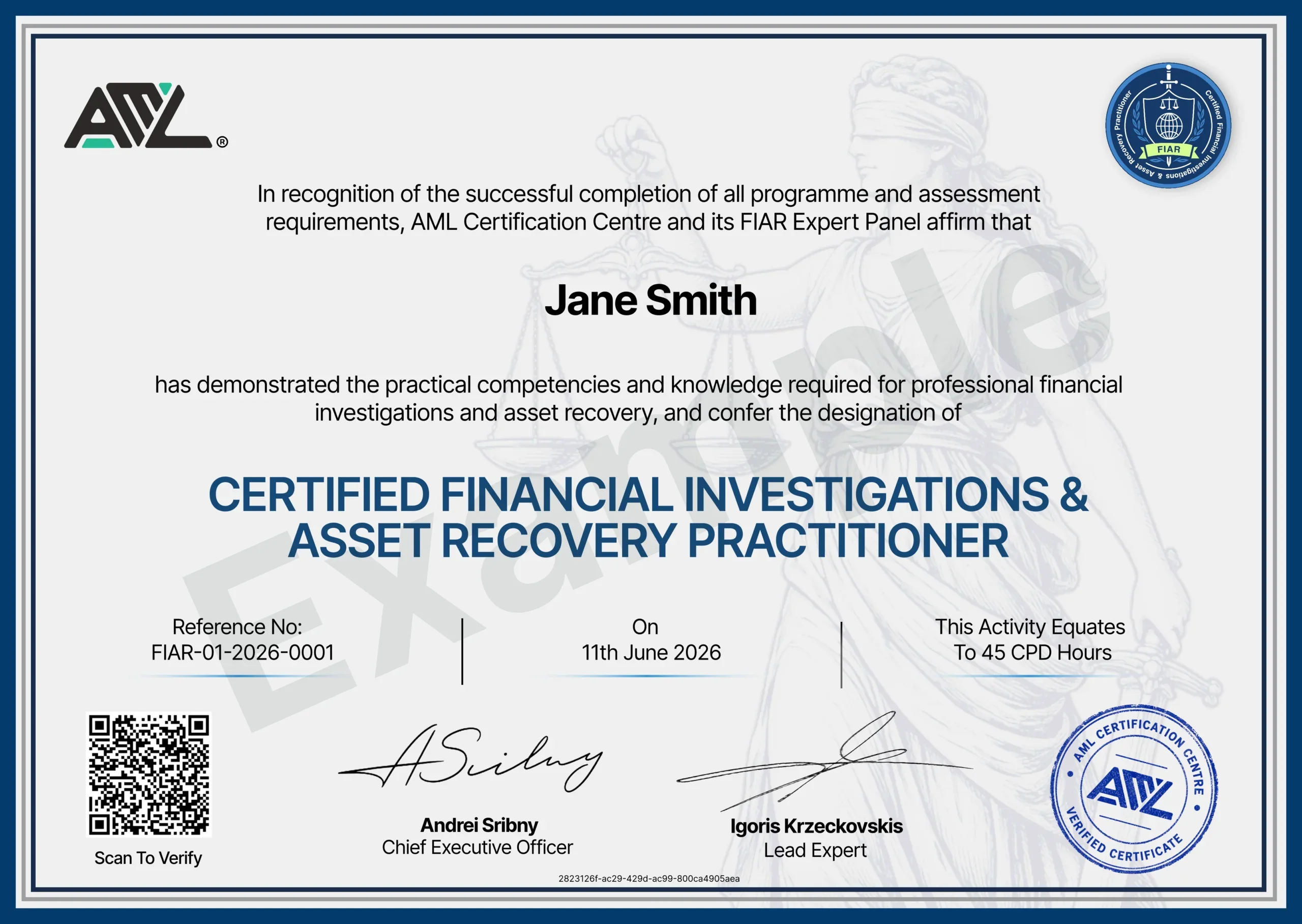
The issued credential connects the learner, programme and completion record through a unique public reference.
Review the exam instructions and applicable retake conditions in your learning platform before starting.
 AML Active
Practical tools, live expert sessions and a record of your continuing development.
Optional membership, separate from your qualification. It never changes the status of a certificate you hold.
Explore membershipExplore risk. Find original sources. Understand the pattern.
Learn and connect with an average of 150 professionals per session.
One included course credit.

Programme lead
Former Head of Lithuania’s Financial Intelligence Department. International expert work in financial crime and asset recovery.
Programme role & profile
Subject-matter expert
Belgian financial investigation practitioner with expertise in the FIU–law enforcement–prosecution interface.
Teaching & profileSubject-matter expert
Financial Crime Compliance Industry Practice Lead, Moody’s.
Crypto investigations expert
Head of Investigations, Global Ledger.
Subject-matter expert
Former investigator at the Estonian Tax & Customs Board.
Start with a scoped pilot, review the learning evidence and plan a cohort around the work your people do.
Institutional programme · 2026
AML Certification Centre was selected by CEPOL through open competitive procurement, scored 95.80/100, to design, develop and deliver this programme.
Read the announcementFIAR is AML Certification Centre’s commercial certification. CEPOL’s Diploma Course is a separate awarded programme, with its own participants, delivery and credential arrangements.
Find the details you need to plan your learning.
FIAR focuses on financial investigation and asset recovery for public-sector practitioners and experienced private-sector investigators. CASS develops broader AML compliance knowledge. Choose FIAR when your work involves tracing assets, evaluating evidence and preparing an investigation.
Yes. The team reviews your professional role and experience to confirm programme fit. Institutional delivery can also be arranged for an agency or organisation.
Check eligibilityRequest a sample-module walkthrough and information about access to a FIAR simulator. The programme team can help you judge the level, format and fit for your role.
Request a sample moduleThe individual route uses self-paced online modules across seven modules. Plan about 45 hours of study over a recommended 5–6 weeks, including casework, assessment and review around your duties. Institutional delivery is agreed with your organisation.
FIAR is taught and assessed in English, and the certificate is issued in English.
Module assessments and decision simulators build towards an integrated capstone case and final examination. Ask for the current assessment specification before enrolment, including progression, pass requirements and retake arrangements.
Explore assessmentAsk the programme team for the current technical requirements and any software used in the learning activities before you enrol. An institutional proposal should identify any separate software or licence requirements.
Check technical requirementsUse the programme’s learning cases for the exercises. Do not include personal data or confidential investigation information in enquiries. If your agency needs learning based on its own material, discuss the scope and information-handling arrangements before sharing anything.
Your certificate does not expire. It records your achievement on its issue date. AML Active is optional continuing development. Membership is separate from the qualification and does not change the status of a certificate you have earned.
Explore optional membershipInstitutional and train-the-trainer licensing can be discussed for police academies and training schools. Delivery scope, support and licensing terms are agreed in the proposal.
Discuss licensingAsk for the curriculum and assessment specification, cohort and invoicing options, relevant security documentation and a Data Processing Agreement. Discuss the completion and assessment records your agency needs; reporting scope and access are agreed with the team.
Security & procurement informationContact us for help with your learning account, enrolment or questions about the programme. If you need an accessibility arrangement or have a question about using the platform for an exam, discuss it with us before enrolling.
Contact learner supportDiscuss your eligibility or a team programme. Public- and private-sector practitioners study the same investigative discipline.
FIUs, asset recovery offices and investigative units.
€1,800 / person
Experienced practitioners and investigation teams.
€2,400 / person
Fees in EUR, including VAT, as published on the FIAR programme page. Cohort, licensing and pilot terms are agreed in your proposal.