

 5/5
5/5- 24
- Advanced
- English
 5/5
5/5 24
24 Advanced
 English
CAPS Certification for Lithuanian CASPs
 CPD-Certified Activity
 - Compliance Programs: Master the development and implementation of comprehensive compliance frameworks, including KYC, CDD, EDD, and transaction monitoring.
- Blockchain and Cryptocurrencies: Gain a thorough understanding of blockchain technology, its core principles, and the various types of cryptocurrencies, including tokens, stablecoins, NFTs, and CBDCs.
- Regulatory Mastery: Understand the Lithuanian AML/CTF+ regulatory approach, focusing on CASP-specific obligations under MLTFPA.
- Cybersecurity in AML/CTF+: Master cybersecurity unique to CASPs, including incident response, penetration testing, and managing IT vulnerabilities in crypto environments.
- Crypto Industry Focus: Explore risks unique to the cryptocurrency sector, such as honeypot, tokenisation, and other CASP-specific risk areas.
- Practical Application: Solve real-world case studies to apply advanced AML/CTF+ concepts in managing risks and responding to regulatory challenges.
Compliant with the new ESMA guidelines of 11 July 2025.
 80 Visual Schemes
  14 Assignments
  84 Submodules of Reading Material
  35 CPD Credits
  Certificate of Completion
  5-6 weeks – Recommended Learning Timeline

Equip senior compliance professionals with CAPS, the highest-level AML certification for experts managing financial crime risks. Designed for MLROs, senior officers, Head and Board Members, it focuses on MiCA and industry-specific compliance. A structured, scalable, and cost-effective way to certify top-level AML professionals and strengthen regulatory leadership.

Find out what you’ll learn in CAPS, Certified Anti-Money Laundering Principal Specialist for Lithuanian Crypto-Asset Service Providers, how long it will last, and what qualifications you’ll gain after completing it.

The CAPS Certification Program for Lithuanian CASPs is designed for professionals aiming to master anti-money laundering (AML), counter-terrorism financing (CTF), and other critical financial crime prevention strategies. This advanced program goes beyond intermediate knowledge, providing in-depth insights into AML/CTF+ compliance, regulatory frameworks, and risk management practices in the Lithuanian crypto sector.
The program equips learners with the knowledge and skills to address complex compliance challenges, ensuring organisations uphold the highest standards of financial integrity.
This comprehensive certification program offers expertise in the following areas:
- Advanced Understanding of Financial Crime Risks. Explore the intricate mechanisms behind financial crimes, including money laundering, terrorism financing, and proliferation financing, and understand their global impact.
- Blockchain and Cryptocurrencies: Core principles of blockchain technology, types of cryptocurrencies, and their regulatory implications.
- Lithuanian Regulatory Framework and approach: Detailed insights into Lithuania’s AML laws, CASP obligations under the MLTFPA, and the role of compliance officers.
- Risk Management: Advanced risk assessment techniques, identifying red flags, and practical strategies for mitigating ML/TF risks.
- Compliance Program Development: Building effective compliance systems, including KYC, transaction monitoring, and governance structures.
- Cybersecurity in AML/CTF+: Addressing IT risks, data privacy under GDPR, and leveraging technology for compliance.
- Reporting and Audits: Best practices for suspicious activity reporting, internal audits, and ensuring readiness for regulatory scrutiny.
- Consequences of Non-Compliance: Real-world case studies highlighting enforcement actions, penalties, and lessons learned.
The CAPS Certification Program combines advanced expertise with an engaging learning experience, featuring:
- Dynamic Video Lectures: Professionally created content to explain complex topics clearly.
- In-Depth Case Studies: Real-world examples to contextualise theoretical knowledge.
- Interactive Quizzes: Test and reinforce your understanding throughout the course.
- Customised Materials: Jurisdiction- and industry-specific guides for practical application.
- Learning Method: Online.
- Duration: 5-6 weeks (flexible, self-paced).
- Materials: Video lectures, detailed textual content, industry-specific case studies, and schemes.
- Final Assessment: Comprehensive exam with 60 questions, 90 minutes to complete.
- Exam passing threshold: 80%
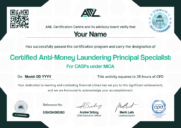
Upon completing the CAPS Certification Program, you will receive the Certified Anti-Money Laundering Principal Specialist (CAPS) designation, recognised as one of the most advanced qualifications in the AML field.
- Globally Recognised Certification: Demonstrates your expertise in AML/CTF+ compliance and risk management.
- Regulatory Expectations: Your qualification becomes aligned with the expectations of local regulators.
- Career Advancement: Enhances your credentials, positioning you for senior roles in compliance, financial crime prevention, and regulatory affairs.
With the CAPS Certification, you’ll not only master advanced AML/CTF+ strategies but also solidify your position as a leader in the fight against financial crime.
- Basic computer and internet skills.
- Knowledge of English at lest B2.
- Professional experience in the field at least 4 years.
- Other high-level professional qualifications.
Contact us to find whether you are eligible.

- Predicate offences for Money Laundering, Terrorist Financing,
- Proliferation Financing and Sanctions
- Understanding Money Laundering, Its Consequences and Its Impact
- Understanding Terrorist Financing, Its Consequences and Its Impact
- Understanding Proliferation Financing, Its Consequences and Its Impact
- International Sanctions: Importance and Why
- Highlights of the previous chapters
- Historical Context
- Core Principles of Blockchain
- Challenges and Considerations
- Key Elements of Cryptocurrency Transactions
- Highlights of the previous chapters
- Virtual Assets, Cryptocurrencies and Crypto-Assets
- Native Assets
- Tokens
- Stablecoins
- Central Bank Digital Currencies
- Highlights of the previous chapters
- EU-wide regulation development
- Lithuanian Regulation Development
- CASP’s Obligations Under MLTFPA
- AML/CO responsibilities
- Highlights of the previous chapters
- Virtual Currency Service
- Virtual Currency Wallet Service
- Virtual Currency Exchange Service
- Virtual Currency Transfer Service
- Tokenisation
- Over-The-Counter Desk
- Market Making
- Online Gaming
- Crypto ATM’s
- Highlights of the previous chapters
- Key elements of an Effective Compliance Program
- Roles and Responsibilities in Compliance
- Compliance Policies and Procedures
- Training and Awareness Programs
- Highlights of the previous chapters
- Risk Management, – Assessment, and – Appetite
- Risk-, Rule-Based Approach
- ML/TF+ Risk Identification
- AML/CTF+ Risk Scoring
- Examples of Risk Assessment Scenarios and Best Practices
- Highlights of the previous chapters
- KYC
- CDD, SDD, EDD
- ODD
- Transaction monitoring
- Highlights of the previous chapters
- Cybersecurity and AML/CTF+
- Incident Response
- Penetration Testing, Black-box, White-box Audits
- Key Aspects of IT Risks in Cryptocurrencies
- Automated technology and systems in AML/CTF+
- Highlights of the previous chapters
- Understanding GDPR and its Importance
- GDPR Compliance in AML/CTF Programs
- Data Subject Rights and AML/CTF+ Obligations
- Ensuring Data Privacy and Security in AML/CTF+ Operations
- Case Studies and Best Practices
- Highlights of the previous chapters
- Investigating Suspicious Activity
- Identifying Suspicious Activity and/or Transaction
- Red Flag Indicators Related to Transactions, Transaction Patterns and Anonymity
- Red Flag Indicators About Senders or Recipients; In the Source of Funds or Wealth; Geographical Risks
- Highlights of the previous chapters
- Principles of the tone from the top and information flow
- Reporting obligation from Employees to the AML Department
- Communication by Employees/MLRO on Towards to Customer
- Reporting From the AML Department to FIU
- General Reporting to the Management Board
- Highlights of the previous chapter
- The importance of the AML/CTF/IS compliance function as a prerequisite function for the internal audit
- Blockchain Preparation Audit Programme
- Audit
- Highlights of the previous chapters
- Enforcement Actions and Penalties for AML/CTF+ Violations
- Utilisation of Non-Compliant Cryptocurrency Exchanges by Criminals for Money Laundering
- Case Studies – Penalties
- Highlights of the previous chapters


Frequently
Asked
Questions
Where does CAPS fit for an AML officer at a Lietuvos bankas-licensed CASP?
Why does Lietuvos bankas care whether AML staff hold advanced qualifications?
Is CAPS accredited, and does Lietuvos bankas recognise it?
What experience is needed before starting CAPS in Lithuania?
What does CAPS add to a Lithuanian CASP’s staff-competence evidence?
Can I enrol in CAPS without CASS or an equivalent qualification?
How does CAPS fit around the annual ML/TF risk assessment cycle?
Is CAPS delivered in Lithuanian?
What does the CAPS exam involve for Lithuanian candidates?
How high is the CAPS pass mark, and why?
What happens if I do not pass the CAPS exam first time?
Will the certificate be recognised beyond Lithuania?
How is the CAPS certificate issued?
What does CAPS cost in Lithuania?
Are discounts available to Lithuanian public-sector staff?
Can a Lithuanian CASP sponsor places for its compliance team?
Subscribe to Newsletter
as well as AML/CTF news.