

 4.6/5
4.6/5- 1,728
- Beginner
- English
 4.6/5
4.6/5 1,728
1,728 Beginner
 English
AML Certification for Banks
 CPD-Certified Course
 AML Foundations Banking Course — CPD-accredited AML/CFT training for compliance, onboarding, and operations staff at retail, corporate, and investment banks. €499, 12 CPD credits, 22 submodules, lifetime access.
AML Foundations for Banking is built for the people who see a bank transaction before anyone in the financial crime department does — the onboarding officer opening a corporate account, the payments clerk releasing a cross-border wire, the relationship manager handed an ownership chart four layers deep.
Banks rarely fail an inspection because a policy was missing. They fail because a control that existed on paper wasn’t applied at the counter, in the operations queue, or on the trade finance desk. Regulation 24 of the UK Money Laundering Regulations 2017 and the FFIEC BSA/AML Examination Manual make the same point from opposite sides of the Atlantic: training is owed to every relevant employee, not only to the second line.
So the programme covers the ground those employees are examined on. Predicate offences, and how proceeds enter a bank in the first place. Customer due diligence and beneficial ownership, including the structures that make a UBO hard to pin down. PEP screening and sanctions screening, and why the two produce different kinds of false positive, which matters when you are the one clearing them. Transaction monitoring: what an alert actually is, who triages it, and how an escalation becomes a SAR or STR. Correspondent banking and trade finance as elevated-risk contexts. Sanctions exposure carried by wire transfers and payment messaging. And de-risking — the reflex to close accounts rather than manage them, which the FATF has warned pushes activity into less transparent channels instead of reducing risk.
You’ll also see where it went wrong for institutions that treated a culture of compliance as a poster on a wall rather than an operating constraint, and what that cost them.
Materials were prepared by practitioners and are presented with animations, diagrams, and worked examples, including 26 visual schemes. Expect roughly 12 hours of structured study, three of them video, across a recommended two weeks. You can pay in full or split the cost into 2 or 3 payments.
 3 hours of on-demand video
  22 Submodules of reading material
  30 Assignments
  Lifetime Access
  12 CPD Credits
  26 Visual Schemes
  Certificate of Completion
  2 weeks – Recommended Learning Timeline


Train your bank’s staff on one syllabus, with records you can put in front of an examiner. AML Foundations for Banking suits new joiners, frontline and onboarding teams, payments and settlements operations, and second-line staff who need a shared baseline before role-specific training starts.
What a corporate buyer gets: €499 per seat, 12 CPD credits per learner, lifetime access so refreshers cost nothing later, and a CPD-accredited certificate issued per completion for the training file. Team pricing is available on request. [verify: confirm volume discount bands, invoicing / purchase-order handling, and VAT treatment for EU business buyers]
Supervisors from the FCA to BaFin ask the same three questions after an incident — who was trained, on what, and when. This gives you a dated answer for every name on the list.

AML Foundations for Banking — Course Overview
Entry level, and honest about it. This is the first of three stages at the AML Certification Centre — AML Foundations, then CASS for specialist depth, then CAPS at principal level. Start here if AML is new to you, or if you’ve worked in a bank for years without ever being taught why the controls exist.
AML job market snapshot (LinkedIn) Source of data: LinkedIn Jobs · Last update: 23.12.2025 · Updated monthly
- 🇪🇺 European Union 11 707 open positions in total · 1 113 entry-level open roles · ≈ 3 610 remote open roles
- 🇬🇧 United Kingdom 3 704 open positions in total · 290 entry-level open roles · ≈ 683 remote open roles
- 🇺🇸 United States 1 834 open positions in total · 620 entry-level open roles · ≈ 124 remote open roles
- 🇦🇪 UAE 235 open positions in total · 40 entry-level open roles · ≈ 45 remote open roles
Read the table as a demand signal, not a promise. Across the EU, the UK, the US, and the GCC the listings run into five figures, and the entry-level share is the part that matters if you’re starting out — 1,113 open roles in the EU, 290 in the UK, 620 in the US, 40 in the UAE. The US number is the interesting one: 620 of 1,834 roles are entry-level, roughly a third of that market, while remote roles there are scarce at about 124.
So the openings exist. What thins the field is that most applicants can’t describe what happens between a transaction monitoring alert and a filed SAR. That gap is exactly what this course closes.
Figures are LinkedIn job-board counts, not vacancies confirmed with employers.

Job titles first, because “bank employee” covers far too much ground.
Retail and branch side: personal bankers, branch operations staff, contact-centre agents fielding account queries, and the onboarding or KYC analysts who clear new customer files. Corporate and institutional side: relationship managers, credit analysts reading loan applications, cash management and payments operations staff, trade finance officers processing letters of credit and documentary collections, treasury and settlements teams, and the correspondent banking desk that maintains nostro and vostro relationships with respondent banks.
Second line: AML and financial crime analysts in their first year, transaction monitoring alert triage staff, sanctions and PEP screening analysts, and CDD/EDD reviewers working periodic refresh cycles. Third line: internal auditors picking up a financial crime audit for the first time, and quality assurance staff sampling closed alerts.
The programme also fits people who don’t sit inside a bank but are judged by bank standards — outsourced KYC operations teams, respondent banks preparing a Wolfsberg CBDDQ response, fintech and EMI compliance staff whose sponsor bank imposes bank-grade controls, payment institution operations teams, and the consultants, auditors, and analysts who review those programmes from outside.
Geography changes the emphasis, not the syllabus. A compliance analyst supervised by the Bank of Lithuania, an onboarding officer under DNB in Amsterdam, an operations lead reporting into BaFin, a Maltese team under the MFSA, a Finnish one under FIN-FSA, and a US banker examined against the FFIEC BSA/AML Examination Manual are all measured against the same FATF Recommendations underneath. National detail differs; the obligations do not. Prudential consequences may land with the ECB’s Single Supervisory Mechanism, but AML supervision itself stays national, which is why the course teaches the common layer and flags where local practice diverges.
And it fits one group nobody plans for: experienced banking staff who have applied controls for years without ever being taught the reasoning behind them. That cohort is larger than most heads of compliance expect. It is also where a foundations course pays back fastest, because the practical knowledge is already there and only the framework is missing.
One honest exclusion. If you already own an AML programme, sign off the enterprise-wide risk assessment, or file SARs as a matter of routine, this sits below your level — go to CASS instead.
Career changers and finance students are welcome. No banking experience is required to start, and no prior AML certification. What’s expected is English at B2 or above and enough patience for 22 submodules and 30 assignments.
Outcomes are written as things you can do at the end, not topics you were shown. Thirty assignments run alongside the 22 submodules, so each one is tested as you go rather than only in the final exam.
By the end of the programme you will be able to:
- Explain a bank’s AML/CFT obligations in your own words and place them against the FATF Recommendations, the EU AML package (AMLR and AMLD6), and your own national supervisor’s rules;
- Take a customer file through the elements of customer due diligence: identification, verification, beneficial ownership, and purpose of the relationship, then say which element a given document actually satisfies;
- Trace a beneficial owner through a two- or three-layer ownership structure, and recognise when the structure itself is the red flag;
- Tell a PEP screening hit apart from a sanctions screening hit, and explain why each is escalated on a different path;
- Read a transaction monitoring alert, decide what further information is needed, and write an escalation a second-line reviewer can act on without coming back to you;
- Describe the SAR/STR route inside an institution — who decides, what deadline applies, and why tipping-off rules limit what you may say to the customer;
- Name the standard red flags in retail deposits, lending, corporate accounts, cross-border wire transfers, and payment messaging;
- Explain why correspondent banking and trade finance carry elevated risk, what a respondent-bank assessment looks for, and why the Wolfsberg CBDDQ exists;
- Argue against reflexive de-risking on the FATF’s own reasoning: that indiscriminate exits push activity into less transparent channels rather than removing risk;
- Handle a high-risk customer profile without either waving it through or refusing it by default.
[verify: confirm the syllabus names the EU AMLR/AMLD6 package, the Wolfsberg CBDDQ, and trade finance red flags explicitly — where a topic is only implied, soften that bullet from “explain” to “recognise when you meet it”]
Two things the course won’t do. It won’t teach your own bank’s policies, thresholds, or systems, because no external programme can, and any that claims otherwise is selling you something. And it won’t make you an MLRO. What it gives you is the shared vocabulary and the reasoning that institution-specific training already assumes you have.
That assumption is the whole problem. Supervisors keep finding staff who completed annual training and still couldn’t say what a beneficial owner is.


- What are Financial Crimes?
- Typology of Financial Crimes
- Consequences and Impacts of Financial Crime
- Understanding of Risk
- What is Financial Crime Risk?
- Risk Management in AML/CTF+ and Financial Crime
- The importance of financial crime risk management
- How FC risk is managed?
- Understanding of Compliance Program
- Foundations of Compliance Programs
- Foundations of KYC
- Foundations of Ongoing Due Diligence
- Sanctions Compliance
- What is Reporting of Suspicious Financial Activities (SAR/STR)?
- Termination of Business Relationship
Understanding of different business sectors
- International Organisations and Frameworks in AML/CTF+
- Who is the Regulator?
- AML/CTF+ difference by country and industry
- Consequences of non-compliance
- Importance of Code of Ethics and Code of Conduct
- Comparison of Code of Ethics and Code of Conduct
7
Insight into the Banking Sector and AML/CTF+ Specifics


- Understanding the Banking Sector’s Business and Risks
- Where AML/CTF+ obligations attach across retail, corporate, and investment banking — onboarding, lending, deposits, payments and wire transfers, correspondent relationships, and trade finance
Two lectures, 15 minutes. This is the sector-context module: it maps a bank’s own business lines onto the AML/CTF+ obligations covered elsewhere in the programme, so a payments clerk and a trade finance officer can each see which part lands on their desk. Correspondent banking and trade finance are introduced here as elevated-risk contexts; the depth treatment sits in CASS. [verify: confirm the second lecture title and its sub-topics against the LMS before publishing]
The exam runs on the same platform as the course. Thirty multiple-choice questions, one hour, 80% to pass. Results appear immediately after you submit, and there’s nothing to schedule in advance.
Eighty per cent is a deliberate bar. A 60% pass mark would let through someone who is wrong about one question in three, and in AML the wrong third is usually the part about escalation. Two minutes per question is comfortable for a scenario item if you’ve worked through the 30 assignments. It isn’t comfortable if you only watched the videos.
Three attempts are included at no extra cost, and your best result is the one that counts. A fourth attempt and any after it cost €70 each. Retakes open 15 days after the previous one — that gap isn’t a penalty, it is there so you go back through the submodules instead of re-guessing the same questions from memory.
What the paper asks for: definitions you have to recall, and scenarios where you choose the correct next action. The scenario items are where people fail. A question of the type “a corporate customer’s ownership chart changes mid-review, what do you do first?” rewards whoever actually read the due diligence material.
Preparation that works, given how the programme is built: complete all 22 submodules, do the 30 assignments as you go rather than in a block at the end, and re-watch the section behind any assignment you got wrong. Two weeks at a few hours a week is the recommended pace. And there’s no deadline for reaching the exam. Lifetime access means you sit it when you’re ready, not when a cohort schedule says so.
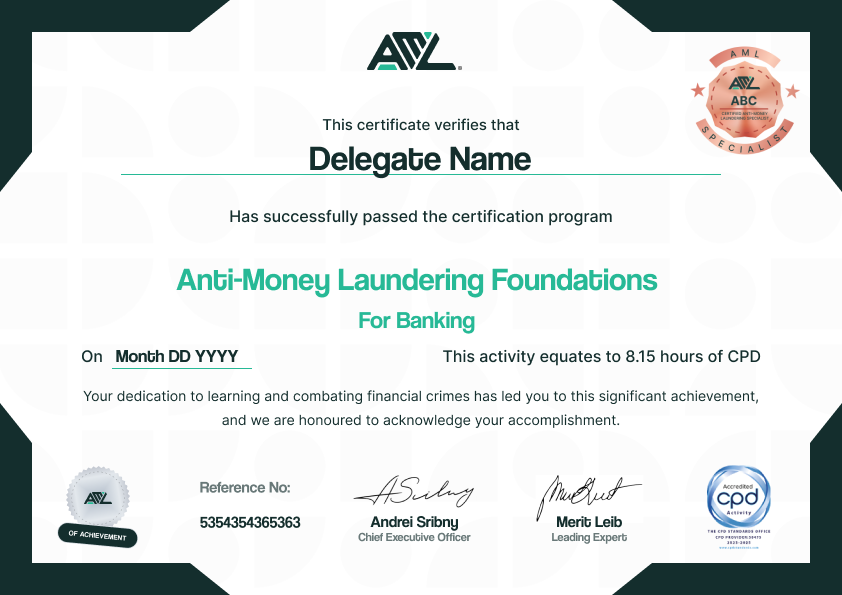
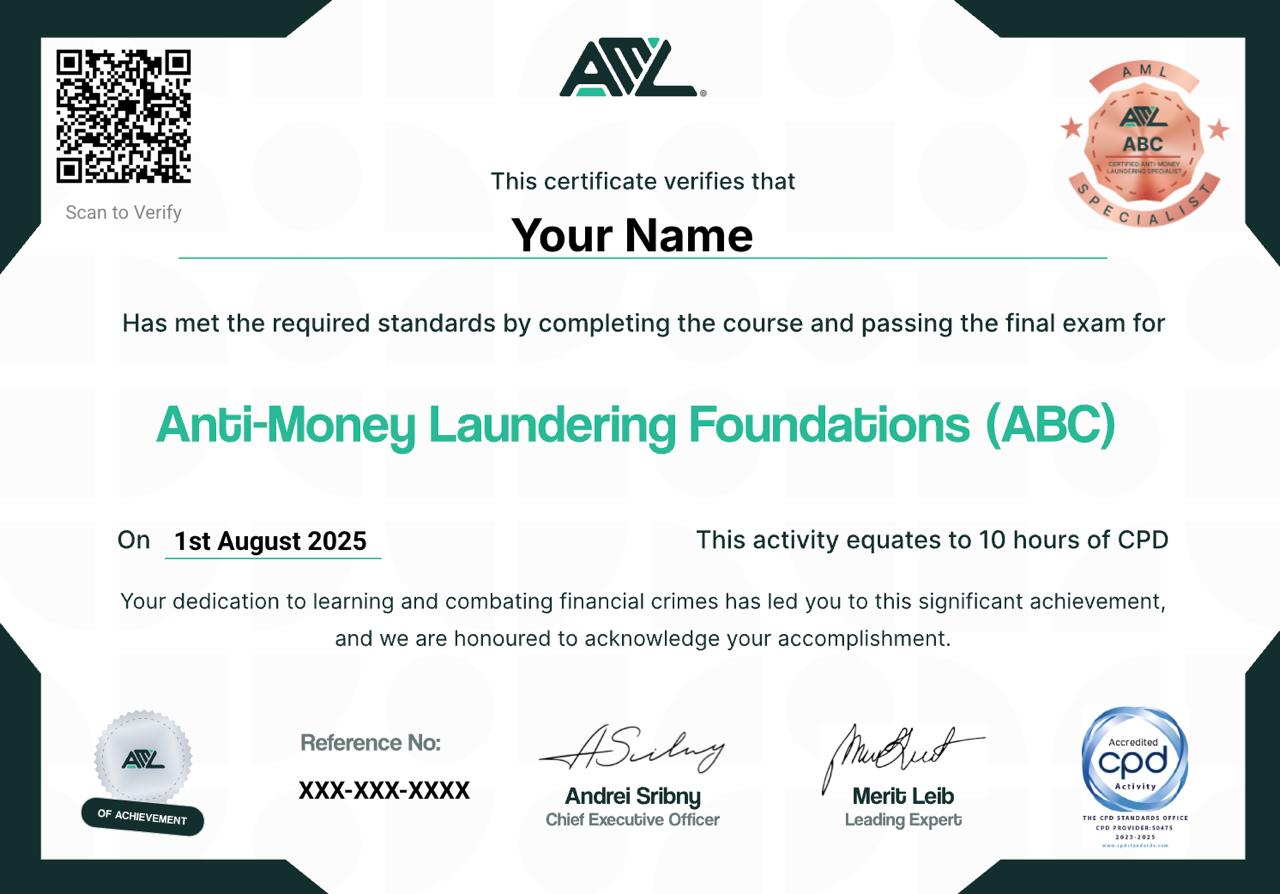
Finish the programme, pass the exam, and you receive a CPD-accredited certificate carrying 12 CPD credits, issued by the AML Certification Centre in Tallinn.
Be clear about what that is and isn’t. CPD accreditation is an independent check that a programme meets continuing professional development standards for structure, learning hours, and assessment. It is not a licence, and no certificate from any training provider makes you an approved person under a national regime. What it does give you is a dated, structured record of learning that an employer can file and a supervisor can read.
The programme is built on the FATF Recommendations, which is why it travels. The same forty Recommendations sit underneath the EU AML package, the UK Money Laundering Regulations 2017, the US Bank Secrecy Act framework set out in the FFIEC BSA/AML Examination Manual, and the UAE regime. National detail differs; the underlying obligations do not. The certificate is recognised in key global jurisdictions, including the EU, the US, the UK, the UAE, and other countries.
Where graduates put it to work:
- retail, corporate, and investment banks, traditional and digital;
- correspondent banking and trade finance desks;
- payment institutions, EMIs, and fintechs held to bank-grade controls by a sponsor bank;
- financial holding companies and investment companies;
- compliance, AML/CTF, and financial monitoring functions;
- risk management, internal control, and internal audit;
- credit organisations and microfinance institutions;
- regulators, auditors, and consultants working in financial security;
- KYC/KYB, transaction monitoring, and financial analytics teams
The certificate is issued digitally and doesn’t expire. But CPD itself is a continuing obligation in most compliance roles, so treat the 12 credits as a contribution to the annual total your employer or professional body asks for, not as a permanent answer. [verify: confirm whether the certificate carries a verification or registry ID a third party can check]
More than 5,000 people have been trained by the AML Certification Centre since 2023, with alumni in 79+ countries.
Three stages, three job levels — where AML Foundations sits and what comes after it
Visual Timeline
AML Foundations
AML/KYC Analyst
CASS
AML Officer/Compliance Specialist
CASS Advanced
Head of Compliance/AML
How AML Foundations boosts your career
AML Foundations, then CASS, then CAPS. Entry-level analyst, then AML officer, then head of function. One syllabus family, each stage priced on its own.

A CV line an employer can check
CPD-accredited, dated, verifiable

30 assignments
you practise before you are tested

A direct route to CASS
senior specialist level, when you are ready

Alumni in 79+ countries
global network
Trusted by professionals from leading companies
Our courses have been attended by specialists working at companies across various industries, from tech and product teams to digital agencies and startups.























Frequently
Asked
Questions
Who should take the AML Foundations for Banking course?
What are the benefits of AML Foundations for Banking certification?
What competencies will you develop in the course?
What are the benefits of taking this course?
What is the difference between the AML Foundations and AML Foundations for Banking courses?
How is the exam conducted?
What are the requirements for course participants?
Can I save course materials on my device?
How long does it take to complete the course?
Are there any additional fees?
What currency is the course price listed in?
How do I get a certificate after completing the course?
Can I ask the instructor questions?
Will I have access to the materials after completing the course?
In which languages is the AML Foundations for Banking course available?
Does the course cover correspondent banking and trade finance?
Does this satisfy my regulator’s AML staff-training requirement?
How is this different from CAMS?
Can my employer pay, and can you invoice a company?
Do I need banking experience before I start?
What comes after AML Foundations for Banking?
Ready to start your AML career?
A short call, not a sales call — your current level, what banks in your jurisdiction actually ask for, and whether Foundations or CASS is the honest place for you to start.
During your Career Call, we will review:
- Your current professional level
- Roles you can qualify for and the skills required
- Overview of your local regulatory requirements
- Your realistic career pathways and growth scenarios
After completing AML Foundations for Banking:
- You can show a dated, CPD-accredited record of 12 hours of structured AML training
- You become eligible for higher-level positions
- You’ll gain deeper, structured AML expertise
- You can present a recognized certification to employers