

 4.9/5
4.9/5- 1,142
- Beginner
- English
 4.9/5
4.9/5 1,142
1,142 Beginner
 English
Crypto AML Course: AML Training for VASPs, CASPs & Blockchain Teams
 CPD-Certified Course
 AML Foundations for VASPs puts anti-money laundering and counter-terrorist financing practice inside the crypto business model rather than beside it. It covers how blockchains, wallets, exchanges, NFTs and token issuance actually move value, and where that movement creates an obligation you have to evidence to a supervisor.
The regulatory floor moved in July 2026. The MiCA transitional period ended on 1 July 2026 across the EU, so a provider serving EU clients now needs full CASP authorisation rather than a legacy national registration (ESMA, Article 143(3)). Alongside it sit the EU Transfer of Funds Regulation, the AML Regulation package, and FATF Recommendation 16, the Travel Rule, which requires originator and beneficiary information to travel with a qualifying transfer. The course treats those four instruments as one operating reality, because that’s how they land on a compliance desk.
Coverage is practical: transaction monitoring for on-chain flows, sanctions screening of wallet addresses, blockchain analytics and on-chain tracing, custody and wallet-service risk, and the typologies attached to stablecoins — e-money tokens and asset-referenced tokens, in MiCA’s own vocabulary. Red flags are drawn from published FATF and supervisory material, not invented examples.
It suits compliance and risk staff at exchanges, OTC desks, custodians and token issuers, plus law enforcement, regulatory officers and analysts.
Delivery is entirely online: 26 submodules, 12 academic hours of reading material, and 4 hours of video with animations, diagrams and worked examples. It carries 12 CPD credits.
One caveat, stated plainly. This is a foundations programme. But if you already run a monitoring desk and can read a clustering graph without help, go straight to CASS — you’ll be bored here, and we’d rather say so than sell you the wrong level.
Payment is flexible. Pay in full, or split the fee into 2 or 3 instalments.
 4 hours of on-demand video
  26 Submodules of reading material
  30 Assignments
  Final Exam
  12 CPD Credits
  26 Visual Schemes
  Certificate of Completion
  2 weeks – Recommended Learning Timeline


Train the team on one current baseline. AML Foundations for VASPs suits new hires, first-line staff on onboarding and withdrawals, and anyone who needs working knowledge of AML rules as they apply to a crypto business rather than to a bank.
For a CASP assembling an authorisation file, or one that has just received authorisation, the practical value is evidence: a dated, CPD-accredited training record showing which staff were trained on Travel Rule fields, wallet screening and MiCA scope. Supervisors ask that question early. So the record matters as much as the knowledge. Structured, scalable, and priced per seat rather than per session, so headcount scales without a new negotiation each time.

AML Foundations for VASPs: what the crypto AML course covers
The entry point for crypto compliance work, and the step before CASS certification and the jurisdiction-scoped CAPS programmes for CASPs in the EU, Germany, Estonia, Lithuania, Poland and Czechia.
AML job market snapshot (LinkedIn) Source of data: LinkedIn Jobs · Last update: 23.12.2025 · Updated monthly
- 🇪🇺 European Union 11 707 open positions in total · 1 113 entry-level open roles · ≈ 3 610 remote open roles
- 🇬🇧 United Kingdom 3 704 open positions in total · 290 entry-level open roles · ≈ 683 remote open roles
- 🇺🇸 United States 1 834 open positions in total · 620 entry-level open roles · ≈ 124 remote open roles
- 🇦🇪 UAE 235 open positions in total · 40 entry-level open roles · ≈ 45 remote open roles
Demand holds across all four markets. But the entry-level share matters more than the headline number: 1 113 entry-level roles in the EU, 620 in the US. That is the segment a foundations certificate competes in.
Two things shape the crypto slice. First, the MiCA transitional period ended on 1 July 2026, so authorised CASPs are staffing compliance functions they previously ran thin. Second, Travel Rule supervision has moved from policy review to transaction testing, which created roles that didn’t have a name three years ago.
Titles worth searching: AML analyst, crypto compliance analyst, transaction monitoring analyst, blockchain investigator, wallet screening analyst, sanctions screening officer, Travel Rule operations. Remote listings are a meaningful share of the EU total.

This course is built for people who make or defend decisions about crypto customers and crypto transactions. The examples, the red flags and the regulatory frame are all crypto. It isn’t a general AML course with a blockchain chapter bolted on.
The clearest fit is first-line staff at a virtual asset service provider: onboarding and KYC officers at centralised exchanges, deposit and withdrawal reviewers, OTC desk operations, and support staff who decide what to escalate. So if your day involves judging whether a deposit from an unhosted wallet gets released, this is your level.
Second, compliance and risk staff at newly authorised CASPs. The MiCA transitional period ended on 1 July 2026, and plenty of firms crossed that line with a compliance function sized for a national registration rather than for full authorisation. And where a team has grown fast, a shared baseline stops three analysts applying three different standards to the same alert.
Third, transaction monitoring and sanctions screening analysts arriving from banking or payments. You already know CDD, EDD, SAR drafting and threshold logic. What’s missing is the on-chain half — address clustering, mixer and bridge exposure, chain-hopping, and why a wallet-address hit is not the same object as a name hit. So the course fills that gap without re-teaching what you know.
Fourth, staff at custody providers, wallet-service firms and token issuers. Custodians observe control changes and destination patterns an exchange never sees. Stablecoin and e-money token issuers see mint and redeem flows that behave like cash in and cash out. Both need people who can name what they are looking at.
Fifth, whoever owns the Travel Rule. Someone at every VASP now owns originator and beneficiary data — collecting it, validating IVMS 101 payloads, running counterparty due diligence before transmission, and handling the cases where the receiving side cannot be reached. That role is usually filled by an internal move rather than a hire, and it is the one we hear about most.
Outside the VASP itself: law enforcement and FIU officers who receive crypto STRs and have to read them; supervisory staff at national authorities coordinated through ESMA and the EBA, including the Estonian FIU, BaFin, the Bank of Lithuania, KNF, ČNB and the MFSA; lawyers and advisers scoping CASP authorisation files; and auditors testing whether a crypto AML programme does what its policy claims.
Recruiters hiring for crypto compliance benefit too. But after this you can tell the difference between a candidate who has run a blockchain analytics query and one who can explain what the result means.
And founders. If you’re building an exchange, a marketplace or a token product, the compliance obligation attaches to the product decision, not to a remediation project two years later. Better to learn that before the authorisation file than during it.
Who it does not suit: if you already run a monitoring desk, own the STR pipeline, or hold an MLRO appointment, start at CASS instead. This is foundations, and we’d rather you skip a level than resent one.
By the end you should be able to look at a crypto transaction and say three things: what happened on-chain, which rule it engages, and what your firm has to do about it. That is the whole design.
The regulatory half covers the instruments that govern a CASP in practice. MiCA and CASP authorisation, including the scope split between custody and administration, operating a trading platform, exchange, transfer services and advice. The Transfer of Funds Regulation and FATF Recommendation 16: which fields must accompany a transfer, what changes above and below threshold, and how transfers to self-hosted wallets are treated. The EU AML Regulation package and what centralised AMLA supervision will mean for a crypto obliged entity. Plus the token taxonomy that decides which rules apply at all: e-money tokens, asset-referenced tokens, and everything else.
The analytical half is on-chain. Reading a transaction graph, address clustering and attribution, tracing across bridges and chains, and recognising mixer, darknet and sanctioned-cluster exposure. You also learn where blockchain analytics stops being evidence and starts being inference. But that distinction matters the moment a decision gets challenged.
What you will learn:
- Apply MiCA CASP obligations to a real service offering, and identify where an activity falls outside scope.
- Implement FATF Recommendation 16 in practice: originator and beneficiary information, counterparty due diligence before transmission, and IVMS 101 payload validation.
- Assess AML risk across CEX, DEX, DeFi, bridges, OTC desks and custody arrangements.
- Recognise obfuscation techniques — mixers, chain-hopping, privacy coins, self-hosted wallets and high-risk jurisdictions.
- Run sanctions screening on wallet addresses, and explain why an address hit and a name hit need different handling.
- Read on-chain data: clustering, attribution, fund-flow tracing and exposure scoring.
- Build a transaction monitoring rationale for crypto flows, and document source of funds where the trail is on-chain.
- Identify red flags specific to stablecoin mint and redeem activity, token sales, NFT wash trading and OTC settlement.
- Draft the on-chain part of an STR so an FIU analyst can follow it.
Why it matters:
An authorised CASP has to show a supervisor that its controls work, not that its policy exists. And since 1 July 2026 there is no transitional cover to fall back on. So the outcome that counts is a team able to defend a decision six months later, in the file, with the reasoning written down.


- What are Financial Crimes?
- Typology of Financial Crimes
- Consequences and Impacts of Financial Crime
- Understanding of Risk
- What is Financial Crime Risk?
- Risk Management in AML/CTF+ and Financial Crime
- The importance of financial crime risk management
- How FC risk is managed?
- Understanding of Compliance Program
- Foundations of Compliance Programs
- Foundations of KYC
- Foundations of Ongoing Due Diligence
- Sanctions Compliance
- What is Reporting of Suspicious Financial Activities (SAR/STR)?
- Termination of Business Relationship
Understanding of different business sectors
- International Organisations and Frameworks in AML/CTF+
- Who is the Regulator?
- AML/CTF+ difference by country and industry
- Consequences of non-compliance
- Importance of Code of Ethics and Code of Conduct
- Comparison of Code of Ethics and Code of Conduct


- Introduction to blockchain, wallets and transaction structure
- Understanding the AML/CTF+ Specifics
- Understanding the VASPs and CASPs Business
- VASP ML/TF+ Common Risks
- MiCA and CASP authorisation scope after 1 July 2026
- FATF Recommendation 16 (Travel Rule) and the EU Transfer of Funds Regulation
- Custody, wallet services and stablecoin issuance risk
- Blockchain analytics, on-chain tracing and wallet-address sanctions screening
After the final submodule there is one exam, taken electronically on the same platform as the course. Thirty questions, single and multiple correct answers, one hour. The pass mark is 80%, and the result appears the moment you submit.
Questions are applied rather than recall-based. Expect a fact pattern — a transfer to a self-hosted wallet, a mint-and-redeem sequence that does not match a stated business purpose, an incoming deposit with mixer exposure two hops back. Then a question about what the obligation is and what you’d do next. Some items ask which Travel Rule field is missing from a transfer record. Others ask which MiCA service category an activity falls into, which is a scoping question that decides everything downstream.
Three attempts are included. Use all three and further retakes cost €70 each. But a retake can’t be booked earlier than 15 days after the previous one. That gap is deliberate: it exists so you go back into the material rather than re-guess the same items.
A note on preparation. Candidates who fail usually fail the on-chain questions, not the regulatory ones. Regulation reads like law and reads once; tracing doesn’t. So if blockchain analysis is new to you, work through the video material twice before you sit it.
One more thing. The exam covers the whole programme, including the AML fundamentals blocks: financial crime typologies, risk, compliance programme design, sanctions, SAR/STR and conduct. Crypto specialists sometimes skim those and lose marks on ground they assumed they had.
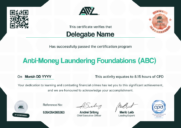
Complete every module, pass the final assessment, and you receive an international certificate carrying CPD accreditation, confirming applied knowledge of AML and CTF as they work inside a cryptoasset business.
It is issued digitally and is independently verifiable: the sample linked below resolves to a live record, not a PDF passed around by email. And that matters more in crypto hiring than elsewhere.
The certificate is built against FATF standards, which is what gives it currency outside any single jurisdiction: the European Union, the United States, the United Kingdom, the UAE and other regulated markets. CPD status means the programme meets international standards for continuing professional development, and the 12 CPD credits count toward the annual requirement most compliance functions now track.
Where a CPD-accredited certificate carries weight:
- compliance and internal control at exchanges, custodians and token issuers;
- financial and operational risk management;
- transaction monitoring, wallet-address sanctions screening and Travel Rule operations;
- regulatory and legal teams preparing or maintaining a CASP authorisation file;
- financial institutions, audit and consulting firms with crypto-facing clients.
It is worth being blunt about what the certificate is not, since the distinction gets blurred in marketing elsewhere. It is not a licence. It does not authorise a firm, and no certificate held by staff satisfies an authorisation requirement on its own. But it does evidence competence, which is the question a supervisor asks about your people, separately from the question it asks about your systems.
The step up from here is CASS, the Certified Anti-Money Laundering Specialist (Senior) programme at €959. Above that sits CAPS, Certified Anti-Money Laundering Principal Specialist, which runs in jurisdiction-scoped versions for CASPs in the EU, Germany, Estonia, Lithuania, Poland and Czechia. Foundations, then specialist, then principal. Most people take the first two and stop, which is a reasonable place to stop.
Where AML Foundations for VASPs takes a crypto compliance career
Foundations, then CASS at specialist level, then CAPS for CASPs in your jurisdiction. Three steps. And stopping after any one of them is a legitimate choice.

25-40% higher chance
of securing job interviews

92% feel more confident
when applying for AML jobs

82% graduates promoted
within 8 months

Alumni in 79+ countries
global network
Trusted by professionals from leading companies
Our courses have been attended by specialists working at companies across various industries, from tech and product teams to digital agencies and startups.





















Ready to start your AML career?


Frequently
Asked
Questions
Who is the AML Foundations for VASPs course intended for?
What are the benefits of the AML Foundations for VASPs certificate?
What crypto compliance skills does the course actually build?
What are the advantages of studying this course?
How is this different from the general AML Foundations course?
What does the final exam test on the crypto side?
How is AML related to cryptocurrency and blockchain?
Are there career opportunities in crypto-POD/FT?
What comes after this — CASS, then CAPS for CASPs?
Do I need blockchain or on-chain experience before starting?
Can I save the course materials?
How long does the course take?
Does the €499 fee cover everything, including retakes?
What currency is the price listed in?
How is the certificate issued and verified by an employer?
What support is there if I get stuck on the on-chain material?
Will I have access to the materials after the course ends?
What language is the course in, and does that matter for EU regulation?
Does this course cover MiCA and CASP authorisation?
Does it cover the FATF Travel Rule at implementation level?
Is this enough for a team preparing a CASP licence application?
How does this differ from Chainalysis or Elliptic tool certifications?
Our compliance team is six people. Can we enrol as a group?
Ready to start your AML career?
Onboarding checks, wallet screening, Travel Rule data: move from first-line crypto AML work to specialist-level judgement a supervisor will accept in an authorisation file or an on-site review.
During your Career Call, we will review:
- Your current professional level
- Roles you can qualify for and the skills required
- Overview of your local regulatory requirements
- Your realistic career pathways and growth scenarios
After Completing AML Foundations for VASPs:
- Your chances of landing an AML/Compliance role increase by 37%
- You become eligible for higher-level positions
- You’ll gain deeper, structured AML expertise
- You can present a recognized certification to employers