

 4.8/5
4.8/5- 84
- Beginner
- English
 4.8/5
4.8/5 84
84 Beginner
 English
AML Foundations for Gambling and iGaming
 CPD-Certified Course
 Gambling AML cases turn on two questions more often than any others: where did this money come from, and could this player afford to lose it. The Gambling Commission’s money laundering and terrorist financing risk assessment for 2026, published on 30 July 2026, added “failure to appropriately scrutinise source of funds documents” as a new risk for remote casino and remote betting alike, and kept both sectors rated High overall. The same tables added a second new risk: training for staff that is insufficient and not appropriately tailored.
AML Foundations for Gambling and iGaming from the AML Certification Centre is built for that second gap. It teaches AML/CTF practice inside the operator’s own workflow rather than beside it: player onboarding and eKYC, deposit and withdrawal patterns, source of funds and source of wealth evidence, affordability triggers, VIP and high-roller handling, and the point where a responsible gambling concern and an AML concern turn out to be the same case file.
Sector typologies get named, because vague ones don’t survive a file review. Chip dumping and collusion in peer-to-peer poker, bonus abuse and arbitrage across linked or duplicate accounts, money mules and third-party payments, chargebacks and stolen-card deposits, structuring below a due diligence threshold, and the withdrawal that follows minimal play. Screening runs alongside: sanctions lists, PEP status and adverse media, plus the third-party payment method that is not in the player’s name.
And regulation is taught as an operating reality, not a reading list. The EU AML Regulation, Regulation (EU) 2024/1624, applies from 10 July 2027 and requires gambling operators to run customer due diligence on stakes or winnings of EUR 2,000 or more, whether that sits in one transaction or a chain of linked ones (Article 19(5)). Around it sit AMLD6 and the national supervisors — the UK Gambling Commission, the Malta Gaming Authority and Malta’s FIAU, Spelinspektionen, the Kansspelautoriteit, ANJ, ADM and the Curacao Gaming Control Board.
Delivery is entirely online: 23 submodules of reading material, 12 hours of coursework, 4 hours of video with animated explainers, diagrams and worked scenarios, and 30 assignments. The programme carries 12 CPD credits and a recommended two-week timeline. It’s the foundations tier — if you already own an operator’s monitoring rules and can defend a threshold to a supervisor, go straight to CASS instead.
Pay 499 EUR in full, or split it across 2 or 3 instalments.
 4 hours of on-demand video
  23 Submodules of reading material
  30 Assignments
  Final Exam
  12 CPD Credits
  26 Visual Schemes
  Certificate of Completion
  2 weeks – Recommended Learning Timeline


Train your KYC, payments and player-safety teams against one syllabus. AML Foundations for Gambling and iGaming suits new hires, frontline staff and analysts who handle onboarding, deposits, withdrawals and VIP accounts, and it gives an MLRO something concrete to show when a supervisor asks how staff training is tailored to the operator’s own risk assessment. Seats can be bought for a team and invoiced to the company. Every learner sits the same 30-question exam and receives a CPD-accredited certificate of completion, so you’ll finish with a record of who was trained, on what, and when. That record is usually what a supervisor asks for first.

AML training for gambling and iGaming: source of funds, affordability and sector typologies
The entry level for gambling compliance work, and the step before CASS certification.
AML job market snapshot (LinkedIn) Source of data: LinkedIn Jobs · Last update: 23.12.2025 · Updated monthly
- 🇪🇺 European Union 11 707 open positions in total · 1 113 entry-level open roles · ≈ 3 610 remote open roles
- 🇬🇧 United Kingdom 3 704 open positions in total · 290 entry-level open roles · ≈ 683 remote open roles
- 🇺🇸 United States 1 834 open positions in total · 620 entry-level open roles · ≈ 124 remote open roles
- 🇦🇪 UAE 235 open positions in total · 40 entry-level open roles · ≈ 45 remote open roles
Demand for AML and financial crime staff holds up across every market in this table, and gambling operators compete for those people with banks and payment firms. Thousands of roles sit open across the EU, the UK, the US and the GCC, with a steady share of entry-level and remote positions. But the gambling slice is narrower than the totals suggest. Operators and their suppliers hire KYC analysts, payments and fraud analysts, transaction monitoring analysts, VIP account managers, responsible gambling officers and deputy MLROs — and most of them want sector knowledge on day one, not six months in. So a general AML credential gets you shortlisted; a gambling one gets you asked better questions.

AML Foundations for Gambling and iGaming is written for the people who actually touch player money at a licensed operator or one of its suppliers. That means KYC and onboarding analysts running eKYC and document checks, payments and fraud analysts watching deposits, withdrawals and chargebacks, transaction monitoring analysts working alerts, VIP and account managers who own the high-roller relationships, and responsible gambling officers whose caseload overlaps with AML more often than either team expects.
It also fits the compliance side of the house: AML officers, deputy MLROs, internal control and audit staff, legal advisers, and MLROs who need a documented, tailored training baseline for a team rather than a generic e-learning module. Suppliers are in scope too, because their risk is real. Payment providers serving gaming operators, B2B content and platform suppliers, affiliate and white-label partners, and the banks and acquirers on the other side of the flow all face questions from the same supervisors.
The course assumes no prior gambling experience. Someone arriving from banking or payments will recognise CDD, sanctions screening and suspicious activity reporting, and they’ll spend their time on what’s different here: peer-to-peer transfer of value between player accounts, loss-based thresholds, bonus mechanics, self-exclusion data, and the fact that a customer’s stated source of funds has to be tested against how they play, not just against a payslip. And that comparison is where most new analysts get stuck.
Students and career changers use it as an entry point. So do regulatory and law enforcement staff who read gambling suspicious activity reports and want to understand what the operator was looking at when the report was raised.
This course builds the working set a gambling compliance role is actually assessed on: reading a player, reading a payment, and being able to write down why you escalated.
What you will learn:
- Run source of funds and source of wealth enquiries on a player account, judge what a bank statement, payslip, business record or crypto exchange statement does and does not prove, and document the decision so it survives a supervisory file review;
- Apply affordability and disproportionate-spend triggers, and recognise where a responsible gambling flag and an AML flag are describing the same player;
- Handle player onboarding and eKYC, including identity documents presented remotely, and the AI-generated documents, deepfake video and face swaps the Gambling Commission reports are being used against remote operators;
- Read deposit and withdrawal patterns: minimal play before withdrawal, structuring below a due diligence threshold, prepaid vouchers and e-wallets, open-loop payment routes, and third-party payment methods that are not in the player’s name;
- Identify sector typologies by name: chip dumping and collusion in peer-to-peer poker, bonus abuse and arbitrage across linked or duplicate accounts, high-turnover slots play used as a wash, money mule networks, chargeback and stolen-card deposits;
- Screen for sanctions exposure, PEP status and adverse media, and explain what an operator does when a match lands on a funded account;
- Manage VIP and high-roller relationships at a licensee where commercial pressure and the risk picture point in opposite directions;
- Locate your obligations across the frameworks that apply to you: the EU AML Regulation and AMLD6, FATF standards, and the rules of your own supervisor, whether that is the UK Gambling Commission, the Malta Gaming Authority, Spelinspektionen, the Kansspelautoriteit, ANJ, ADM or the Curacao Gaming Control Board;
- Escalate properly: internal report, MLRO review, and the external suspicious activity or transaction report your jurisdiction requires;
- Decide on risk mitigation, up to and including account closure and termination of the business relationship.
Why it matters: the Gambling Commission’s 2026 risk assessment rates remote casino and remote betting High for money laundering, and lists insufficient, untailored staff training as a new operator-control risk in both. Training is the control a supervisor can inspect fastest, and it’s the one that leaves a paper trail whether you built it well or not.


- What are Financial Crimes?
- Typology of Financial Crimes
- Consequences and Impacts of Financial Crime
- Understanding of Risk
- What is Financial Crime Risk?
- Risk Management in AML/CTF+ and Financial Crime
- The importance of financial crime risk management
- How FC risk is managed?
- Understanding of Compliance Program
- Foundations of Compliance Programs
- Foundations of KYC
- Foundations of Ongoing Due Diligence
- Sanctions Compliance
- What is Reporting of Suspicious Financial Activities (SAR/STR)?
- Termination of Business Relationship
Understanding of the business sectors that carry AML/CTF+ obligations, and where gambling and iGaming sit alongside banking, payments and crypto in a supervisor’s risk ranking
- International Organisations and Frameworks in AML/CTF+
- Who is the Regulator?
- AML/CTF+ difference by country and industry
- Consequences of non-compliance
- Importance of Code of Ethics and Code of Conduct
- Comparison of Code of Ethics and Code of Conduct


- How gambling and iGaming operators make money, and where that model creates money laundering and terrorist financing exposure
- Sector red flags: source of funds gaps, disproportionate spend, third-party and mule account use, and peer-to-peer transfer of value between player accounts
- Why remote operators carry higher risk than land-based ones, and what that means for onboarding and ongoing monitoring
After you finish every training module of AML Foundations for Gambling and iGaming, there is a mandatory exam. It runs online on the same platform as the course. Thirty multiple-choice questions, 60 minutes, and a pass mark of 80%. The result appears as soon as you submit.
Questions are drawn from all seven modules, so the regulatory and ethics material counts as much as the sector material. And candidates who fail usually fail the scenario items, not the definitions. Expect to be asked about scenarios rather than definitions: which control failed, what the operator should have collected, when the obligation to escalate arose.
Each student gets three free attempts. Once those are used, further retakes are chargeable at 70 EUR each. There is also a 15-day wait between attempts, which is deliberate — it gives you time to go back over the modules that caught you out rather than re-sitting the same paper twice in one afternoon. You won’t pass by memorising the questions.
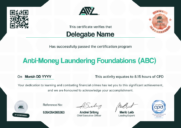
Finish AML Foundations for Gambling and iGaming and you receive an international CPD-accredited certificate confirming that you completed the programme’s modules and passed the final assessment. It records competence in anti-money laundering and counter-terrorist financing as it applies to gambling, betting and online gaming.
The certificate is built against FATF methodology and global AML standards, which is why it reads the same to an employer in the EU, the US, the UK, the UAE and other regulated markets. CPD status confirms the programme meets international continuing professional development standards. Employers in compliance, risk and financial crime treat that as evidence a candidate has been trained to a documented syllabus.
One thing it isn’t. It’s not a licence, and it’s not endorsed, approved, mandated or recognised by any gambling regulator — not the UK Gambling Commission, not the Malta Gaming Authority, not Spelinspektionen, the Kansspelautoriteit, ANJ, ADM or the Curacao Gaming Control Board. What it evidences is the competence of a person. Authorisation of a business is a separate matter, decided by the supervisor, and no training provider can grant it. Anyone who tells you otherwise is selling something.
CPD-accredited documents are used across gambling and its adjacent sectors, including:
- online and land-based casinos;
- sportsbooks, betting shops and remote betting operators;
- iGaming platforms and B2B gaming content suppliers;
- white-label and affiliate partners of licensed operators;
- payment providers, acquirers and e-wallet firms serving gaming operators;
- banks and financial institutions with gambling customers;
- AML, compliance, risk and responsible gambling teams;
- audit and consulting firms working with the gambling sector;
- regulators and licensing authorities supervising AML/CTF;
- KYC, KYB and AML technology vendors.
For an individual, the practical value is narrow and real: it shows a hiring manager that you have been taught source of funds work, affordability triggers and gambling typologies to a standard, rather than picking them up from whichever licensee employed you last.
Where AML Foundations for Gambling and iGaming takes a compliance career
From onboarding, payments and VIP review work to MLRO-track roles at licensed operators and their suppliers

25-40% higher chance
of securing job interviews

92% feel more confident
when applying for AML jobs

82% graduates promoted
within 8 months

Alumni in 79+ countries
global network
Trusted by professionals from leading companies
Our courses have been taken by specialists across regulated and technology sectors — compliance, risk, legal, payments and product teams.















Ready to start your AML career?


Frequently
Asked
Questions
Who is the AML Foundations for Gambling and iGaming course for?
What is the AML Foundations for Gambling and iGaming certificate worth to an employer?
What can I do after this course that I cannot do now?
Why take a gambling-specific AML course rather than a general one?
How is this different from the general AML Foundations course?
How is the exam conducted, and what does it test?
Do I need gambling experience before I start?
Can I keep the red flag material to use on the desk afterwards?
How long does it take if I am working shifts on a live operations desk?
Are there any additional fees beyond the course price?
Can our company buy seats and pay by invoice?
How do I get the certificate, and can an employer verify it?
Can I ask questions about a real case I am working on?
Do I keep access to the material after I finish?
What language is the course in, and does that work for a multi-market team?
Does the course cover source of funds and affordability checks?
Will this satisfy our licence condition on staff AML training?
Does it cover crypto deposits at gambling operators?
What comes after this course?
Does the course connect responsible gambling and AML?
Ready to move beyond foundations?
Move from operational gambling AML work — onboarding, payments, VIP reviews — to specialist-level expertise recognised across regulated sectors.
During your Career & Regulatory Call, we will review:
- Where you sit today: operator, supplier, payment provider or regulator
- Which gambling compliance roles you can qualify for, and what each one needs
- Your market's supervisor — UKGC, MGA, Spelinspektionen, KSA, ANJ, ADM or Curacao GCB
- A realistic route from analyst to MLRO, and how long each step tends to take
After Completing the AML Foundations for Gambling and iGaming Course:
- Your chances of landing an AML/Compliance role increase by 37%
- You qualify for CASS, the senior specialist tier
- You can work a source of funds or affordability case from flag to escalation
- You hold a CPD-accredited certificate an employer can verify