

When 1% Recovery Is the Norm, the System Needs to Change
AML Certification Centre at the European Police Congress 2026 — on financial investigations, crypto-related crime, and the limits of “follow the money”.
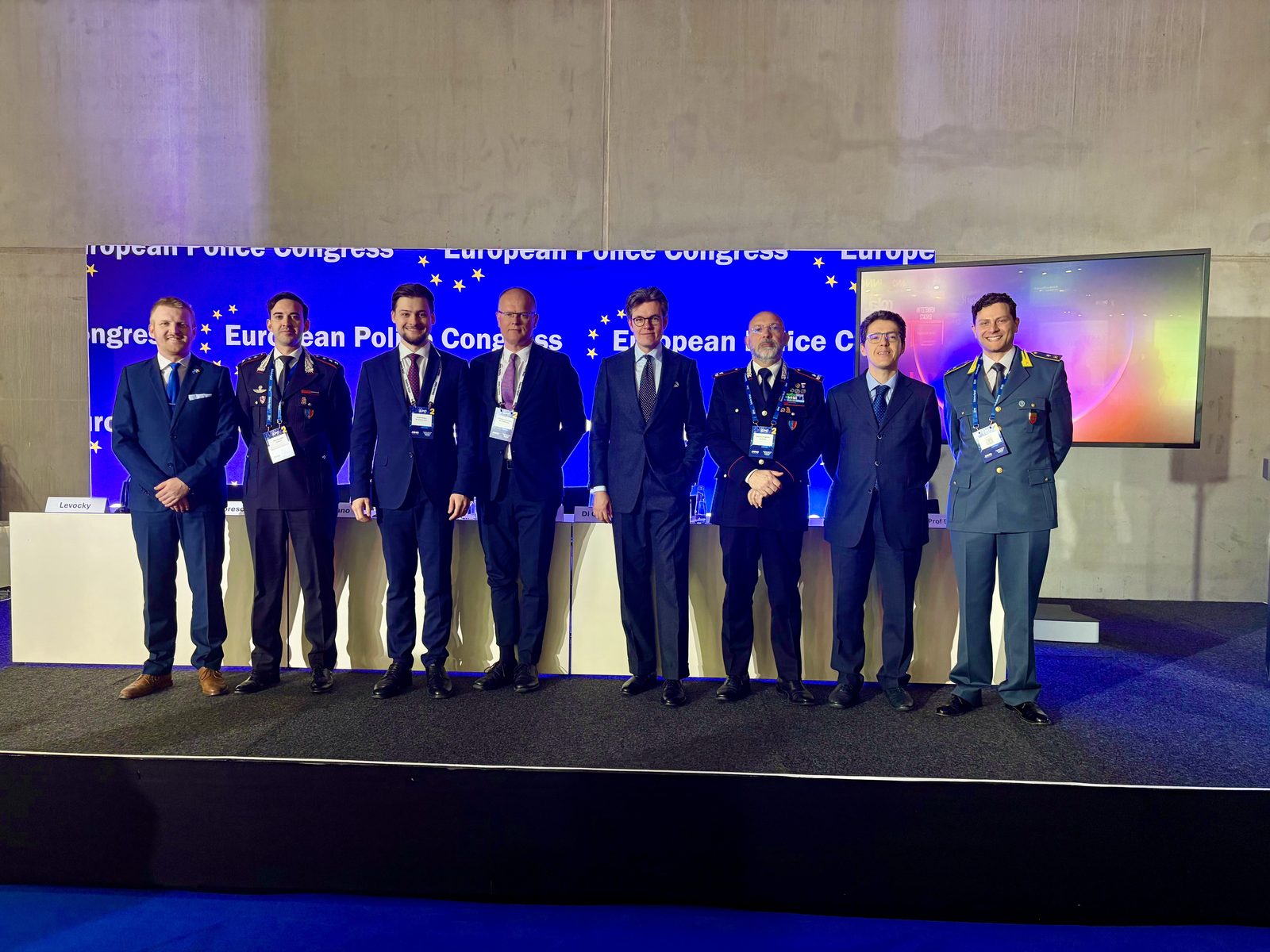
AML Certification Centre participated in the European Police Congress 2026 in Berlin, joining ongoing discussions on financial investigations, crypto-related crime, and the future of law enforcement capabilities across Europe. The sessions brought together senior representatives from European institutions, national law enforcement agencies, and the financial supervisory community to address a shared challenge: the criminal financial landscape is evolving faster than the frameworks designed to address it.
The Crypto Dimension: Institutions Adapting in Real Time
A significant portion of the Congress focused on the growing role of crypto-assets in financial crime — and the operational responses being built within law enforcement to match it.
Representatives of the Italian Carabinieri shared current risks, investigative approaches, and the practical challenges linked to crypto-asset investigations. Of particular note was the Carabinieri’s establishment of a dedicated cryptocurrency investigations section within its own organisational structure — a direct institutional response to the growing complexity of digital financial crime. When a national gendarmerie of this scale formalises a specialist crypto unit, it reflects a broader shift across European law enforcement.
The role of supervision was also central to the discussions. Nico Di Gabriele of the ECB contributed perspectives on evolving supervisory expectations and the risks linked to digital assets — with particular attention to the challenges posed by self-hosted wallets and the oversight gaps they create for both banking institutions and crypto-asset service providers (CASPs).
Bitcoin to Stablecoins: The Pace of Shift
One data point from the Congress captures the speed of change in this space:
While Bitcoin was among the most commonly encountered crypto-assets in investigations in 2022, stablecoins are now appearing with far greater frequency in both investigations and enforcement discussions. The pace of that transition illustrates how quickly operational realities are outrunning existing training and capability frameworks — and why continuous capacity-building is no longer optional.
The Limits of “Follow the Money”
One of the substantive contributions AML Certification Centre brought to the Congress concerned a methodological challenge at the core of financial investigations today. The prevailing “follow the money” paradigm — tracing transaction flows through the formal financial system — was built for a different era. Today’s money laundering schemes are faster, more layered, and increasingly routed through instruments and jurisdictions that sit outside or at the margins of that system.
The CEPOL OTNA 2025 report on criminal finance, money laundering, and asset recovery confirmed what practitioners already know: investigative capacity is not keeping pace with the sophistication of criminal finance. The gap is not only technical — it is methodological and conceptual.
- Reconstructs flows backward from suspicious payments
- Dependent on formal financial system records
- Fails when layering crosses informal channels
- Reaches dead ends in crypto and offshore structures
- Reactive by design
- Proactively maps the full asset footprint of a subject
- Covers real property, corporate holdings, crypto wallets
- Integrates lifestyle indicators and cross-border registrations
- Builds the evidential picture from the asset outward
- Works where transactional tracing reaches its limits
This methodological reorientation — toward “follow the assets” — does not replace traditional financial intelligence. It extends it. Rather than working backward from a suspicious payment, investigators proactively map the full asset profile of a subject, and build the evidential picture from there. This approach is particularly relevant in cases involving crypto-assets, shell structures, and layering across multiple jurisdictions.
When only 1% of criminal assets are recovered, and when the mechanisms of illicit finance are evolving faster than the institutions tasked with addressing them, the investment in practical investigative capability is not a programme choice — it is a foundational operational requirement.
AML Certification Centre — European Police Congress 2026Building Practical Investigative Capability
AML Certification Centre has been working on exactly this challenge for several years, developing practical training frameworks in close collaboration with European institutions, FIUs, prosecutors, and law enforcement practitioners. The discussions in Berlin reinforced both the direction of that work and the urgency behind it.
More updates from the European Police Congress will follow. For those working in financial investigations, asset recovery, or financial crime enforcement, the gap between current recovery rates and what is technically achievable has never been a clearer argument for structured, evidence-led professional development.