

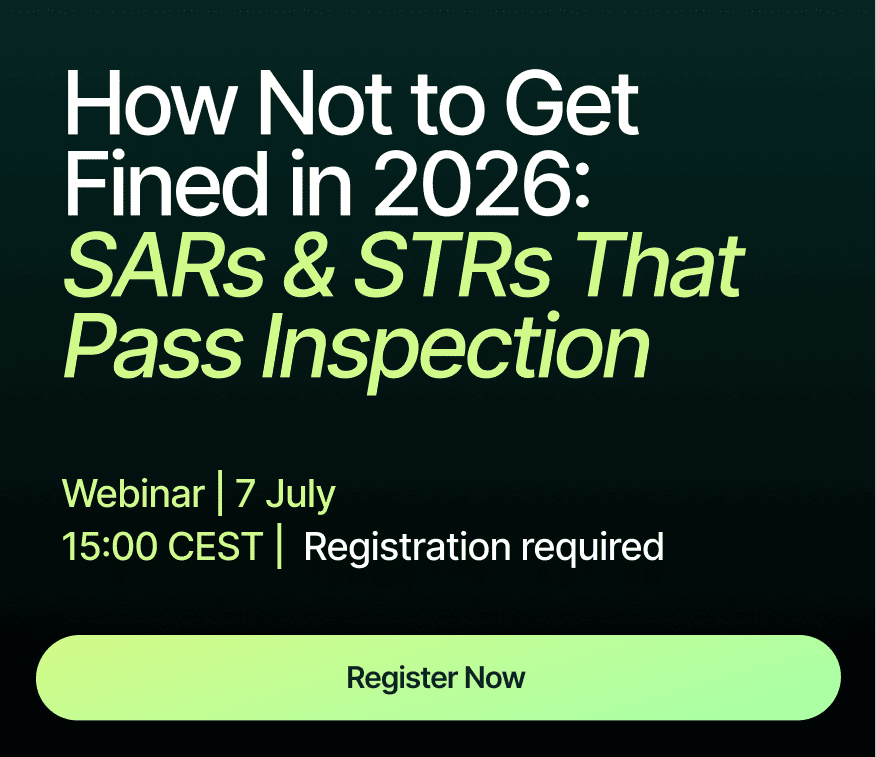

How Not to Get Fined in 2026: SARs & STRs That Pass Inspection
How to write SARs and STRs that satisfy regulators, pass audit, and actually get used.

Andrei Sribny
Chief Executive Officer
AML Certification Centre

Viktor Tkatsenko
AML Expert & MLRO
Citadele banka Estonian Branch

Date
07 July, 2026

Time
15:00 СET

Most SARs and STRs don’t fail because compliance teams don’t care. They fail because nobody showed them the standard.
Regulators in 2026 are not just counting reports — they are reading them. Quality expectations have tightened across the EU, UK, and beyond: vague narratives, missing red flags, and unsupported suspicion assessments are now a direct route to findings, fines, and remediation orders.
Join Andrei Sribny and Viktor Tkatsenko on 30 June at 15:00 CEST for a practical session on what separates a SAR or STR that passes inspection from one that creates regulatory exposure — and how to close that gap in your team’s reporting practice.
Everyone who registers receives the STR Logbook — a ready-to-use working tool — immediately on sign-up.

- What regulators actually look for when they review SARs and STRs in 2026
- The most common failure points — narratives, suspicion grounds, and timing
- How to structure a report that documents the decision, not just the transaction
- STR Logbook walkthrough — how to use it in daily compliance work
- Live Q&A — bring your real reporting questions
A practical session on SAR and STR quality for compliance professionals who want their reports to hold up under regulatory scrutiny — with a free STR Logbook for every registrant.
Related Webinars

Webinar
Jan 26 • 60 min
From Exposure to Action: Risk-Based Use of Blockchain Analytics in AML


Webinar
Jul 17 • 60 min
How AI is Enhancing Human Judgment in Financial Crime Detection