

 4.9/5
4.9/5- 1,142
- Beginner
- English
 4.9/5
4.9/5 1,142
1,142 Beginner
 English
AML Foundations for Cryptoasset and Blockchain
 CPD-Certified Course
 AML Foundations for Cryptoasset and Blockchain is a modern educational program that combines basic knowledge of anti-money laundering and counter-terrorist financing with the specifics of the crypto industry. It provides a systematic understanding of how blockchain, cryptocurrencies, NFTs, and related financial crimes work.
The program combines fundamental knowledge about digital assets with practical tools for investigation and AML/CTF compliance. Based on real-life cases and current industry practices, participants learn about the nature of financial crimes, the motivation of offenders, mechanisms for “cleaning” digital assets, and ways to integrate them into financial systems.
The course was developed by industry experts and is aimed at compliance and risk specialists, law enforcement and regulatory officials, analysts, and those seeking to start a career in combating financial crime in the crypto ecosystem.
The course is delivered entirely online. The course curriculum includes 12 academic hours of educational content and 4 hours of video materials with animations, diagrams, and practical examples.
For the convenience of students, a flexible payment system is provided: you can pay the entire amount at once or take advantage of the option to split it into 2 or 3 separate payments.
 4 hours of on-demand video
  26 Submodules of reading material
  30 Assignments
  Final Exam
  12 CPD Credits
  26 Visual Schemes
  Certificate of Completion
  2 weeks – Recommended Learning Timeline

Certify your employees with globally recognised AML certification. AML Foundations for Crypto is ideal for new hires, frontline staff, and professionals seeking a strong understanding of AML principles in the crypto sector. A structured, scalable, and cost-effective way to build essential compliance knowledge and ensure regulatory alignment across industries.

AML Foundations for Cryptoasset and Blockchain: Fundamental Course Overview
Designed for those starting their journey in financial crime prevention, this course is your entry before CASS certification.
AML job market snapshot (LinkedIn) Source of data: LinkedIn Jobs · Last update: 23.12.2025 · Updated monthly
- 🇪🇺 European Union 11 707 open positions in total · 1 113 entry-level open roles · ≈ 3 610 remote open roles
- 🇬🇧 United Kingdom 3 704 open positions in total · 290 entry-level open roles · ≈ 683 remote open roles
- 🇺🇸 United States 1 834 open positions in total · 620 entry-level open roles · ≈ 124 remote open roles
- 🇦🇪 UAE 235 open positions in total · 40 entry-level open roles · ≈ 45 remote open roles
Overall, the data shows a consistently strong demand for AML for Cryptoasset and Blockchain and financial crime professionals across major markets. Thousands of open roles are currently available in the EU, the UK, the US, and the GCC, with a steady share of entry-level and remote positions supporting both new entrants and experienced specialists.

The course is aimed at those involved in customer verification, transaction processing, and financial crime risk mitigation, regardless of their level of training. It is suitable for those who are just starting out in AML/KYC and are looking for a clear foundation for a confident start, as well as specialists from the first line of defense in fintech and payment services who deal with customer data, operations, and risks on a daily basis.
The program will be useful for bank employees who need regular AML training to comply with regulatory requirements, and specialists from crypto and Web3 projects, where the risk of money laundering and financing of illegal activities is particularly high, and the requirements of the EU and other jurisdictions are becoming increasingly stringent.
The course is also suitable for representatives of companies involved in business registration, account opening, and corporate structuring, as it is important for them to understand their AML control responsibilities and minimize ML/TF risks. Lawyers and consultants specializing in international structures and corporate law will find practical insights into how AML/CFT regulations affect transactions, client support, and cross-border operations.
This program from the AML Certification Centre is useful for entrepreneurs in high-risk industries who need to protect their businesses from blockages, fines, and reputational consequences. We especially recommend it for crypto startups, financial marketplaces, and forex companies.
After completing the course, HR specialists working with FinTech/Banking vacancies or AML/KYC recruitment will be able to more accurately assess candidates’ competencies, while risk and fraud monitoring staff will deepen their understanding of ML/TF risks and improve their methods for identifying suspicious activity.
Finally, the AML Foundation course is suitable for internal control and internal audit teams at a basic level who need to understand how to assess the effectiveness of AML processes and the company’s compliance with regulatory requirements.
The AML Foundations for Cryptoasset and Blockchain course provides a comprehensive understanding of how digital assets, wallets, and transaction chains work, and why competent blockchain analysis has become a key element of modern compliance. Participants will learn about tools for tracking crypto transactions, principles for interpreting on-chain data, and global requirements for regulating virtual assets, including FATF recommendations and VASP obligations. The course helps participants see the real risks and typical vulnerabilities of crypto services, understand the logic of regulators, and learn how to apply this knowledge to ensure the transparency and sustainability of crypto platforms.
What you will learn:
- Understand AML risks associated with virtual assets, transaction chains, DeFi, DEX, and CEX.
- Recognize obfuscation schemes, mixers, private wallets, and high-risk jurisdictions.
- Understand the principles of on-chain data analysis.
- Determine the sources of funds.
- Understand global crypto regulations (EU, UK) and KYC/AML requirements;
- Distinguish red flags for OTC transactions, token sales, and NFT projects.
Why is this necessary:
To comply with European regulatory requirements, minimize the risk of operations being shut down, and ensure the transparency of the crypto platform.


- What are Financial Crimes?
- Typology of Financial Crimes
- Consequences and Impacts of Financial Crime
- Understanding of Risk
- What is Financial Crime Risk?
- Risk Management in AML/CTF+ and Financial Crime
- The importance of financial crime risk management
- How FC risk is managed?
- Understanding of Compliance Program
- Foundations of Compliance Programs
- Foundations of KYC
- Foundations of Ongoing Due Diligence
- Sanctions Compliance
- What is Reporting of Suspicious Financial Activities (SAR/STR)?
- Termination of Business Relationship
Understanding of different business sectors
- International Organisations and Frameworks in AML/CTF+
- Who is the Regulator?
- AML/CTF+ difference by country and industry
- Consequences of non-compliance
- Importance of Code of Ethics and Code of Conduct
- Comparison of Code of Ethics and Code of Conduct


- Introduction to blockchain
- Understanding the AML/CTF+ Specifics
- Understanding the VASPs Business
- VASP ML/TF+ Common Risks
After completing all the course modules, participants must take a final exam. It is conducted electronically via the same learning platform used for the course. The exam itself consists of 30 questions, where you need to choose one or more correct answers from the options provided. You have one hour to complete the exam. To pass the exam and receive a positive result, you need to answer at least 80% of the questions correctly. The result is announced immediately after the test is submitted.
Each student is given three free attempts. If all free attempts have been used up, further retakes are subject to a fee of €70 each. The exam can be retaken no earlier than 15 days after the previous attempt, which allows students to prepare further and work on difficult topics.
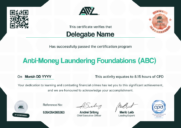
Upon completion of the AML Foundations for Cryptoasset and Blockchain course, students receive an international certificate with CPD accreditation, which confirms a comprehensive understanding of the principles of anti-money laundering and countering the financing of terrorism in the context of cryptoassets and blockchain. The certificate attests to the successful completion of all core course modules and the final assessment.
The document has been developed in line with the global standards and recommendations of the FATF, ensuring its recognition in various jurisdictions, including the European Union, the United States, the United Kingdom, the UAE, and other regulated markets.
CPD (Continuing Professional Development) status guarantees that the course meets international standards for continuing professional development and is in demand by employers in the fields of compliance, risk management, and financial security.
CPD-accredited documents are in demand in a wide variety of areas related to risk, compliance, and crypto assets, including:
- compliance and control within organizations;
- financial and operational risk management;
- working with crypto assets and blockchain technologies;
- regulatory and legal departments of companies;
- financial institutions, auditing, and consulting.
Having a CPD-accredited certificate allows specialists to confirm their professional qualifications in the field of AML/CFT and significantly increase their competitiveness in the international labor market.
How AML Foundations boosts your career
Follow a structured path from foundation to leadership in financial compliance

25-40% higher chance
of securing job interviews

92% feel more confident
when applying for AML jobs

82% graduates promoted
within 8 months

Alumni in 79+ countries
global network
Trusted by professionals from leading companies
Our courses have been attended by specialists working at companies across various industries, from tech and product teams to digital agencies and startups.














Ready to start your AML career?


Frequently
Asked
Questions
Who is the AML Foundations for Cryptoasset and Blockchain course intended for?
What are the benefits of the AML Foundations for Cryptoasset and Blockchain course certificate?
What skills does the course develop?
What are the advantages of studying this course?
What is the difference between the AML Foundations and AML Foundations for Cryptoasset and Blockchain courses?
How is the exam conducted?
How is AML related to cryptocurrency and blockchain?
Are there career opportunities in crypto-POD/FT?
Will the certificate help advance crypto compliance?
What are the requirements for course participants?
Can I save the course materials?
How long does the course take?
Are there any additional fees?
What currency is the price listed in?
How do I get a certificate upon completion of the course?
Can I ask the instructor questions?
Will I have access to the materials after the course ends?
In what languages are the course materials available?
Ready to start your AML career?
Move from operational AML knowledge to specialist-level expertise recognised across regulated sectors.
During your Career Call, we will review:
- Your current professional level
- Roles you can qualify for and the skills required
- Overview of your local regulatory requirements
- Your realistic career pathways and growth scenarios
After Completing the AML Foundations for Cryptoasset and Blockchain Course:
- Your chances of landing an AML/Compliance role increase by 37%
- You become eligible for higher-level positions
- You’ll gain deeper, structured AML expertise
- You can present a recognized certification to employers