

 4.8/5
4.8/5- 102
- Beginner
- English
 4.8/5
4.8/5 102
102 Beginner
 English
AML Foundations EMIs
 CPD-Certified Course
 - Foundational knowledge: A deep exploration of various financial crimes and predicate offenses leading to understanding.
- Risk management: Understand the details of risk evaluation and effective ways to manage it.
- Compliance programs: Learn the necessary elements of being compliant, such as KYC, CDD, CIP, etc.
- Regulatory understanding: Develop an awareness about regulators and have a deft touch on global/regional AML/CTF+ rules.
- Industry specifics: Look into the peculiarities of EMI’s sector by considering its business mechanics and ML/TF matters.
- Ethics and conduct: Understand ethical principles and conduct practices that sustain integrity in this domain.
- Practical application: Use practical case studies while learning AML/CTF+ concepts, making you better at it.
- Terminology mastery: Acquire dexterity in the language spoken by AML/CTF+ professionals.
 4 hours of on-demand video
  23 Submodules of reading material
  30 Assignments
  Final Exam
  12 CPD Credits
  26 Visual Schemes
  Certificate of Completion
  2 weeks – Recommended Learning Timeline

Certify your employees with globally recognised AML certification. AML Foundations for EMIs is ideal for new hires, frontline staff, and professionals seeking a strong understanding of AML principles in the context of Electronic Money Institutions. A structured, scalable, and cost-effective way to build essential compliance knowledge and ensure regulatory alignment across the fintech and payments industry.

AML Foundation for EMIs Course Overview
Designed for those starting their journey in financial crime prevention, this course is your entry before CASS certification.
AML job market snapshot (LinkedIn) Source of data: LinkedIn Jobs · Last update: 23.12.2025 · Updated monthly
- 🇪🇺 European Union 11 707 open positions in total · 1 113 entry-level open roles · ≈ 3 610 remote open roles
- 🇬🇧 United Kingdom 3 704 open positions in total · 290 entry-level open roles · ≈ 683 remote open roles
- 🇺🇸 United States 1 834 open positions in total · 620 entry-level open roles · ≈ 124 remote open roles
- 🇦🇪 UAE 235 open positions in total · 40 entry-level open roles · ≈ 45 remote open roles
Overall, the data shows a consistently strong demand for AML for EMIs and financial crime professionals across major markets. Thousands of open roles are currently available in the EU, the UK, the US, and the GCC, with a steady share of entry-level and remote positions supporting both new entrants and experienced specialists.
The AML Foundations (ABC) for EMIs course serves as an introduction to the fundamental principles of anti-money laundering, counter-terrorism financing, and other financial crimes (AML/CTF+).

- An in-depth overview of financial crimes and predicate offenses, taking a look at their motivations, methodologies, and consequences.
- Understanding risk and its management regarding anti-financial crime actions.
- Foundational knowledge of compliance programs, including components involved alongside practical insights.
- Learning effective strategies for mitigating financial crime risks and discerning when to terminate business relationships.
- Understanding regulatory bodies, typical regulations, compliance protocols, and repercussions of non-compliance.
- Recognizing the importance as well as the difference between a Code of Ethics and a Code of Conduct.
Prepared by leading field experts, this material will give you all the info you must know.
There are animated videos that help in retention, while professionally crafted schematics and visuals simplify comprehension of complex topics.
Embark on the AML Foundations (ABC) for EMIs course so as to start your journey towards becoming an accomplished Anti-Financial Crime Specialist within the EMIs sector.
The AML EMIs course is provided by the AML Certification Centre and is structured to cover the fundamentals of anti-financial crime for professionals working in or entering the Electronic Money Institution (EMI) sector. It focuses on key AML/CTF principles, regulatory expectations, and risk management practices specific to digital payments and fintech operations. Here are some details about the course and its qualifications:
- Learning method: online.
- Duration of course materials: 12 hours.
- Duration of video materials: 4 hours.
- Format: video, textual materials, diagrams.
- Practical materials: yes.
- Interactive quizzes: yes.
- Final exam: 30 questions.
- Duration of final exam: 60-minute time frame.
- Exam passing threshold: 80%
After you finish taking the AML Foundations (ABC) for EMIs through the AML Certification Centre, you will be given a Certificate of Completion. This respected document demonstrates that you have completed the course successfully, indicating that you fully understand AML/CTF+ basics. It also shows your ability to keep up with regulatory requirements and preserve financial integrity. This award attests to how committed you are to progress in your career and your understanding of the basic tenets of AML/CTF+.
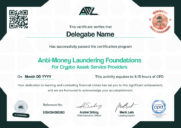
- Proficiency in English, at least at the B2 level, is required.
- A keen interest in grasping the principles of anti-money laundering, counter-terrorism financing, countering the financing of terrorism, proliferation financing, and other financial crimes is necessary.
- An aspiration to pursue a career in the EMIs sector is highly encouraged.
Finishing the course means that besides improving your knowledge and abilities on anti-financial crime issues, you also recognize professional development as well as expertise in such a critical field.


- What are Financial Crimes?
- Typology of Financial Crimes
- Consequences and Impacts of Financial Crime
- Understanding of Risk
- What is Financial Crime Risk?
- Risk Management in AML/CTF+ and Financial Crime
- The importance of financial crime risk management
- How FC risk is managed?
- Understanding of Compliance Program
- Foundations of Compliance Programs
- Foundations of KYC
- Foundations of Ongoing Due Diligence
- Sanctions Compliance
- What is Reporting of Suspicious Financial Activities (SAR/STR)?
- Termination of Business Relationship
Understanding of different business sectors
- International Organisations and Frameworks in AML/CTF+
- Who is the Regulator?
- AML/CTF+ difference by country and industry
- Consequences of non-compliance
- Importance of Code of Ethics and Code of Conduct
- Comparison of Code of Ethics and Code of Conduct
- Understanding of EMIs Business and Risks
How AML Foundations boosts your career
Follow a structured path from foundation to leadership in financial compliance

25-40% higher chance
of securing job interviews

92% feel more confident
when applying for AML jobs

82% graduates promoted
within 8 months

Alumni in 79+ countries
global network
Trusted by professionals from leading companies
Our courses have been attended by specialists working at companies across various industries, from tech and product teams to digital agencies and startups.




















Ready to start your AML career?


Frequently
Asked
Questions
Who is the AML Foundations EMIs course for?
What are the benefits of the AML Foundations EMIs certification?
What skills will I learn in the AML Foundations EMIs course?
What are the benefits of taking the course?
Who is the AML Foundations EMIs course designed for?
How is the examination process done?
Ready to start your AML career?
Move from operational AML knowledge to specialist-level expertise recognised across regulated sectors.
During your Career Call, we will review:
- Your current professional level
- Roles you can qualify for and the skills required
- Overview of your local regulatory requirements
- Your realistic career pathways and growth scenarios
After Completing the AML Foundations for EMIs Course:
- Your chances of landing an AML/Compliance role increase by 37%
- You become eligible for higher-level positions
- You’ll gain deeper, structured AML expertise
- You can present a recognized certification to employers